Brooke Petersen: Teaching at the Intersection of Faith and Care
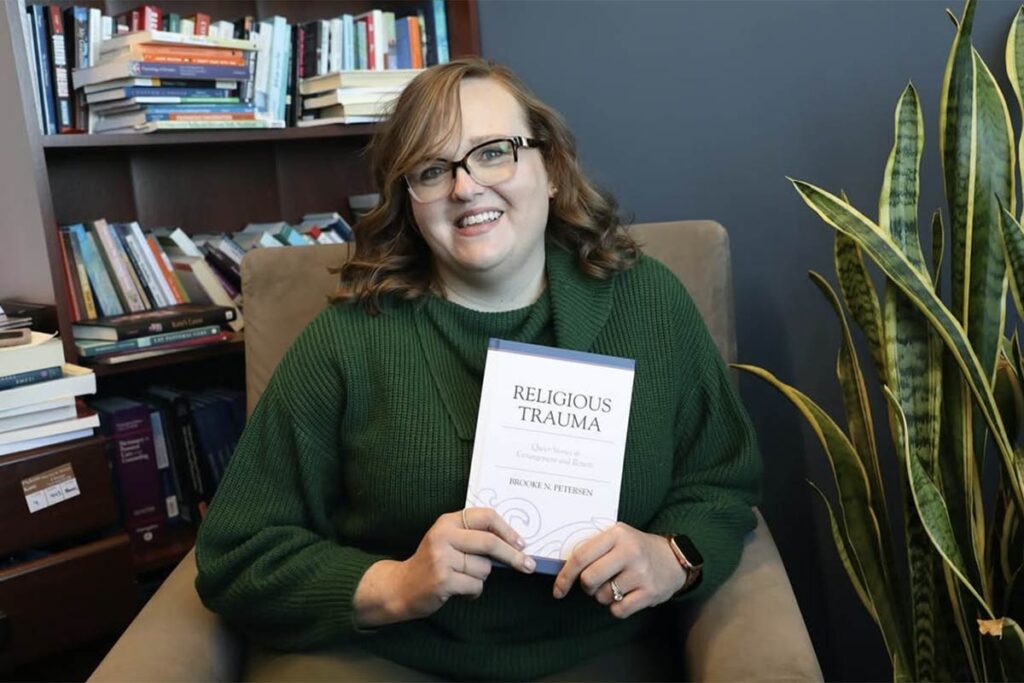
When Brooke Petersen looks at the world around her, she does not begin with theory. She begins with people. People asking questions at hospital bedsides, people navigating grief and joy in the same breath, people wondering what it means to live a life of faith in the midst of uncertainty. From there, her work takes shape, grounded in the belief that theology must remain connected to lived experience.
At LSTC, Petersen carries a range of roles that span teaching, leadership, and formation. She serves as the John H. Tietjen Chair of Pastoral Ministry, Associate Professor of Pastoral Care, Director of MDiv, MA, and MAM Programs, and Director of ELCA Candidacy. She often jokes that her full title would not fit on an office door, but titles alone do not capture the heart of her work. Beyond them, she understands herself first as a person of faith called to clinical and caregiving work.
“When we look at the world around us,” Petersen explains, “what is most needed is healing… It’s a painful time in the world. And so my purpose is to help equip people to be able to step into that.”
That commitment moves through every part of her work, shaping how she teaches, mentors, and imagines the future of theological education.
Before joining the LSTC faculty in 2023, Petersen served as a pastor for six years and later completed her PhD in Pastoral Theology. She describes that time as a turning point, when her understanding of theological education shifted from something she once imagined into something grounded in lived experience. That perspective now informs her classroom, where she prepares students to engage real-world challenges, especially conversations around mental health, through a theological lens.
“So when someone says I have a depression diagnosis, does this mean God isn’t with me? Or, what does this mean about how God created me?” says Petersen. “My students can talk about how God creates us… and answer questions about what it means to be a person of faith with a particular diagnosis.”
Alongside this integration of clinical and theological insight, Petersen’s expertise in religious trauma shapes a central part of her teaching. She approaches the classroom with an awareness that many students arrive carrying complex, and sometimes painful, experiences with faith. Being trauma informed, for her, means not only preparing students to care for others, but also honoring what they themselves bring into the room.
Through her research, she has found that many who pursue theological education do so after navigating difficult experiences within religious communities. For some, those experiences become part of what draws them back to faith. They arrive holding both questions and a desire for healing.
“That’s such an interesting and challenging place to be,” says Petersen. “You’re studying things that have hurt you, and even as you’re studying things that have hurt you, you’re trying to reclaim that toward healing.”
Not every student names their experience as trauma, but nearly all carry some form of religious stress. For many, these experiences shape how they engage learning, especially if they come from communities where questioning was discouraged. In those spaces, doubt may have been seen as something to avoid. In theological education, it becomes essential.
“And so now they’re in a theological school and questions are the most important part,” says Petersen. “We are creating a space where a person can bring their whole self, including those parts… that make it difficult to engage in some of the work we’re doing.
For Petersen, acknowledging trauma is not about centering pain for its own sake. It is about recognizing that these experiences shape who people are and how they show up in the world. Future pastors and caregivers do not enter ministry untouched by their past. Instead, those experiences can become part of how they relate to others, offering the possibility of empathy and connection.
She emphasizes the importance of what she describes as a redemption story, not to minimize harm, but to make meaning from it. In this framework, trauma is neither hidden nor ignored. It becomes part of a larger story that can inform how individuals care for others facing similar struggles.
Petersen’s vision of theological education extends beyond the classroom and into the broader shape of ministry. She prepares her students through the lens of the “public church,” a model that moves past institutional boundaries and emphasizes that ministry is not confined to a single setting. It unfolds in hospitals, communities, protests, and everyday spaces where questions of faith arise.
This approach reflects a broader shift in theological education, one that emphasizes adaptability and integration. Students are not trained for a single role or environment. Instead, they are formed to navigate a range of contexts, bringing theological insight into conversation with social realities.
Even as she looks toward the future, Petersen remains attentive to the present. She acknowledges the tensions shaping contemporary Christianity, where faith can be experienced as both a source of hope and a source of harm. Her work is to help students acknowledge that tension while still imagining what is possible.
“We can help students be dreamers of a future that we cannot yet see,” she says, “and shape people who want to work towards that future.”
In the classroom, that vision often appears in small moments. A student makes a connection between theory and practice. A concept discussed in class takes on new meaning through lived experience. These moments signal a deeper transformation, one that continues beyond the classroom as students carry what they have learned into the lives of others.
It is in those moments of connection that the meaning of her work becomes most visible. She sees herself as one step in a larger process that extends beyond a single course, unfolding over time through the lives and relationships her students will shape.
It is, as she describes, sacred work, moving quietly but steadily toward a more attentive and compassionate world for future communities of faith and for the generations who will inherit them.