Called into Relationship: Bishop Erik Christensen and the Work of a Changing Church
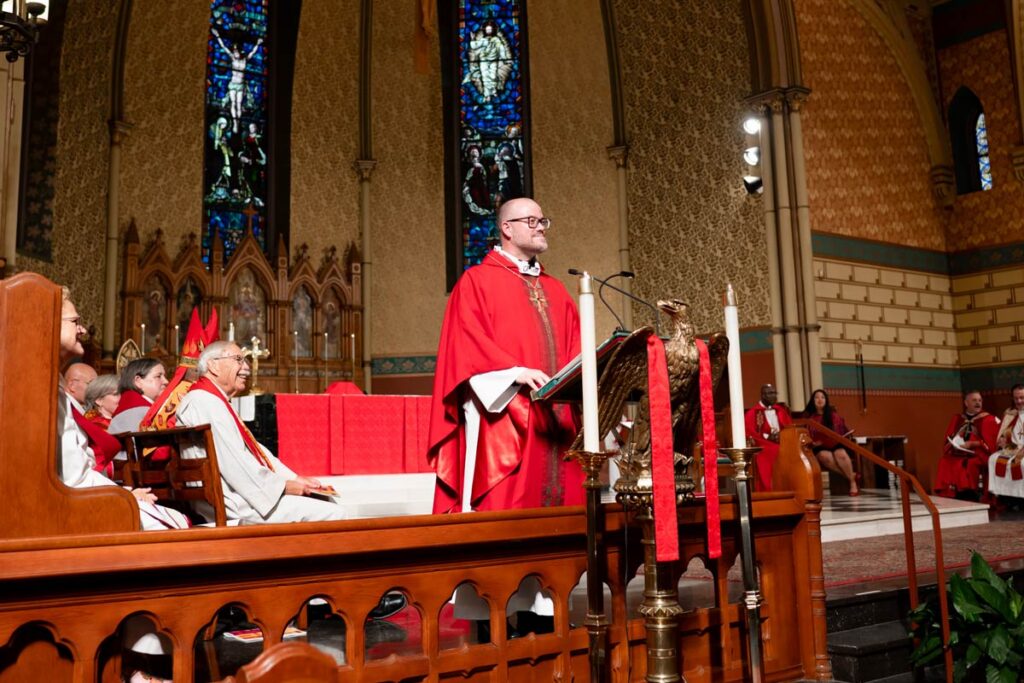
When Bishop Erik Christensen thinks about the path that led him to his new role as bishop of the Metropolitan Chicago Synod, he can trace much of it through relationships.
Some of those relationships began in congregations. Others developed through years of mentoring future church leaders. And again and again, they included relationships with students, leaders, and alums of LSTC.
Christensen, who was elected bishop of the Metropolitan Chicago Synod in June of 2026 and installed in September, served at LSTC from 2017 to 2024, first as pastor to the community and director of worship and later as director of strategic initiatives. Before coming to the seminary, he spent 11 years as the redevelopment pastor at St. Luke’s Lutheran Church of Logan Square.
During those years at St. Luke’s, Christensen mentored 18 students, many of them from LSTC. Working alongside people preparing for ministry became an important part of his own formation as a pastor.
“Having students who are in the process of being formed for ministry shadow you, ask you questions, and getting to mentor and guide them as they did that work always made me a better pastor,” he said.
When a position opened at LSTC in 2017, Christensen was not looking to leave parish ministry. In fact, he still describes St. Luke’s as his “first love in parish ministry.” It was students and alumni he had mentored, along with members of the LSTC faculty, who encouraged him to imagine another way of serving the church.
Nearly a decade later, that pattern repeated itself.
Christensen had not planned to pursue the office of bishop. But while attending LSTC’s third annual Queer Symposium earlier this year, where he had been invited to preach at opening worship, friends and colleagues encouraged him to reconsider. Then, while he was in the chapel at LSTC, he received a call from a group of younger clergy, including former students and LSTC alums, asking him to let his name go forward.
“These aren’t anonymous people to me,” Christensen said. “These are former students. These are mentees, these are colleagues, these are friends. And I take their guidance seriously.”
Their encouragement helped Christensen see the office of bishop through a familiar lens: as another opportunity to invest in the people who are leading the church.
“Just like being a mentor to seminarians in the parish, the office of bishop gives me an opportunity to continue investing in the church’s leadership and in its congregations in a new way,” he said.
That commitment to forming leaders also shapes how Christensen understands the relationship between synods and seminaries at a moment of significant change.
His seven years at LSTC, he said, were “a fantastic training ground” for synodical ministry. Both seminaries and synods are asking how the church identifies, supports, forms and connects leaders across an increasingly diverse landscape. That includes pastors and deacons, but also lay leaders, chaplains, academics, camp leaders and people serving in other forms of ministry.
At the same time, familiar models of congregational life and theological education are changing. The assumption of one congregation, one building and one full-time pastor can no longer be taken for granted. Neither can the assumption that theological education primarily happens through several uninterrupted years of residential study.
For Christensen, those changes make partnership more important, not less.
“Leadership formation is about more than information. It’s about more than content,” he said. “It’s about formation for relational leadership, and that happens in relationship.”
That conviction closely connects the work of LSTC with the work of the Metropolitan Chicago Synod. As LSTC develops new ways of making theological education accessible throughout people’s lives and ministries, synods and congregations can provide the relationships and local contexts in which that learning takes root.
Christensen sees LSTC’s willingness to change as essential to that work. Change can carry real grief, he said, whether it occurs in a congregation reconsidering its future or a seminary reconsidering how it serves the church. But it can also make new forms of ministry possible.
“By getting in front of that change, LSTC is able to actually make the gifts of the academy, the gifts of seminary education, theological education, more accessible to a wider range of people,” he said.
That work is rooted in a question Christensen believes the church must continually ask: How do we build relationships with people we do not already know?
It is a question that reaches beyond institutional sustainability. For Christensen, it is about carrying the transformational power of the gospel into communities and relationships the church has not yet encountered.
Even amid institutional change, social polarization and what Christensen calls the world’s “strong implicit curriculum in despair,” he finds reason for hope in the people who continue to answer calls to ministry.
“Despite all evidence to the contrary, people keep showing up to churches, to seminaries, with a story of call and vocation,” he said.
They arrive at different ages and through different paths, convinced that their lives can participate in, as he says, “God’s work of life and love and liberation and healing and reconciliation.”
As Christensen begins his ministry as bishop, he hopes LSTC and the Metropolitan Chicago Synod will continue that work together through accompaniment, a practice that requires humility, curiosity, honesty and a willingness to be changed by one another.
For Christensen, that is also theological education at its best. “It is not just providing the right answers to someone else’s questions,” he said. “It is accompanying each other and learning to identify and share our own questions, and to be changed by each other’s questions.”
Bishop Christensen’s vision of formation does not end with a degree, a new call or an election. It continues through relationships, through questions and through the communities willing to walk alongside one another in the hope for a more just, equitable, and sustainable future.