“History Is Right Now:” Inside LSTC’s Conversation on Reparations, Memory, and Moral Responsibility
By Rhiannon Koehler
On Tuesday, May 19, 2026, members of LSTC’s Board of Directors gathered for a conversation that reached far beyond budgets, governance, or institutional planning. The topic before them was reparations: not as abstraction, slogan, or political shorthand, but as a living question about responsibility, community, and what it means for an institution to inhabit a neighborhood honestly.
The conversation also reflected broader questions LSTC has been actively engaging as an institution in recent years through its commitments to anti-racism, Public Church theology, restorative justice, and community partnership. As a seminary rooted on Chicago’s South Side, board leaders framed the discussion not as a detached political exercise, but as part of an ongoing discernment about what faithful institutional presence, accountability, and repair look like in relationship to the communities surrounding LSTC.
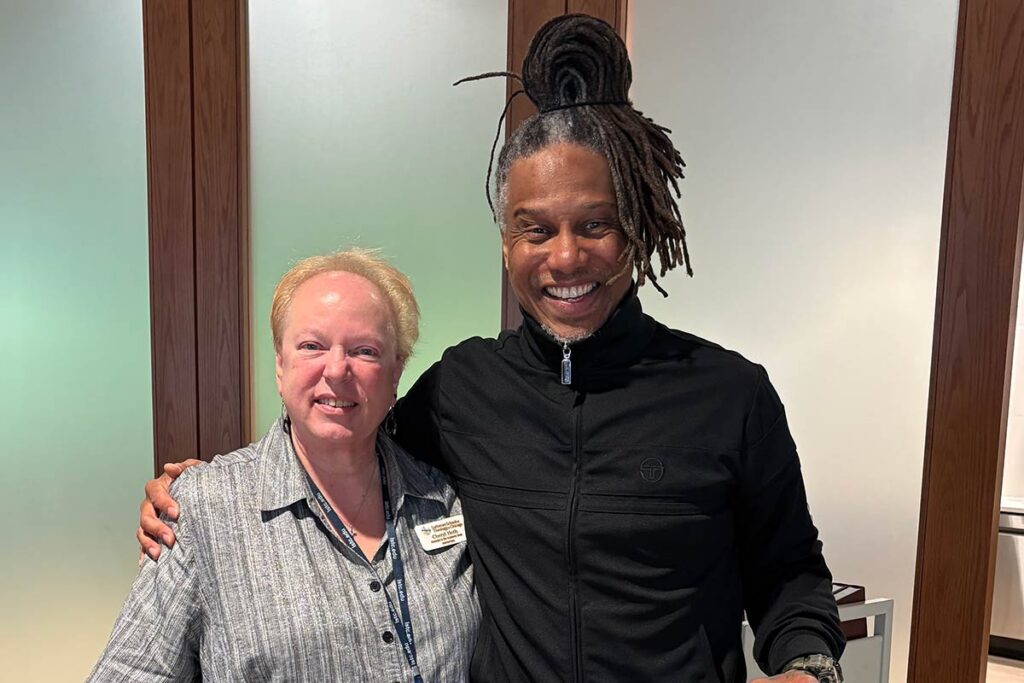
The conversation was directed by Dr. David Stovall, professor of Black Studies and Criminology, Law & Justice at the University of Illinois Chicago, whose work has long examined the intersections of race, education, housing, and justice in Chicago communities. Over the course of the conversation, Stovall urged participants to think concretely about what repair looks like in practice, especially for institutions rooted on Chicago’s South Side.
The discussion began with an acknowledgment from board leaders that Hyde Park cannot be understood in isolation from the surrounding South Side neighborhoods that shape its reality. “We often will say LSTC in Hyde Park,” said LSTC’s Vice President and Dean of Academic Affairs and Associate Professor of Authentic Diversity, Justice, and Public Church Robert Smith, who facilitated the conversation, “but Hyde Park is not isolated from all the surrounding realities.”
For Stovall, reparative work begins with a simple but demanding question: who has been subject to injustice, and what would it mean to place those communities first?
“I think one of the things that’s important is, who has been marginalized?” he said. “We are clear that there’s some things that have happened here, but we want to make sure that we are contributing to the lifeblood of this place, [and] that includes the marginalized first.”
Again and again, Stovall returned to intentionality. Too often, he suggested, institutions engage in highly visible forms of giving that fail to ask what communities actually need. “A lot of times, when you talk about any kind of giving,” he observed, “it’s always just fanfare, right? But the thing is always, what do folks need? And then how do we address what it is that people need?”
The conversation unfolded against the backdrop of profound demographic shifts in Chicago. Stovall pointed to the ongoing displacement of Black residents from the city, noting that Chicago has lost roughly 350,000 Black residents since 1980, with most of that decline occurring after 2000 as affordability pressures intensified across neighborhoods.
Rather than speaking in abstractions, Stovall highlighted specific institutions already doing the work of sustaining community life. He pointed to Kozminski Community Academy, a neighborhood school serving families from Hyde Park and Washington Park, and described it as a place where investment could have tangible impact. Unlike some nearby schools with extensive private resources, Kozminski represents a different reality within the same geography.
He also referenced the work of artists and educators at the Hyde Park Art Center, where youth programming has created spaces for filmmaking, artmaking, and community expression. Such organizations, he suggested, offer models for partnership rooted not in institutional control, but in accompaniment and support.
That distinction mattered deeply throughout the discussion. Stovall repeatedly cautioned against institutions arriving with predetermined solutions.
“What are you all doing?” Stovall asked, describing the kind of conversations institutions should have with schools, teachers, principals, and young people. “What’s the need here? And now how do we use the resources that we have to support that need?”
For many in the room, the conversation resonated with work already underway at LSTC through anti-racism initiatives, restorative justice efforts, Public Church commitments, and the seminary’s Reparations Clearinghouse initiative. Board members discussed how those commitments might move from broad aspiration toward more grounded, community-centered practice.
The discussion also widened to include examples of reparative justice already unfolding in Chicago itself. Stovall pointed to the Chicago Torture Justice Center as a powerful local model. Created in response to decades of police torture carried out under former Chicago police commander John Burge and the so-called “Midnight Crew,” the initiative led to one of the nation’s most significant municipal reparations ordinances. Survivors and families received financial settlements, counseling resources, and educational support, including lifetime access to City Colleges of Chicago for family members.
“And again, they’re up the street,” Stovall noted, emphasizing that models for repair already exist within the city’s own history.
As the conversation continued, it moved beyond local partnerships into questions of institutional courage in a moment of national political backlash against diversity, equity, and critical historical inquiry. Stovall spoke candidly about the growing number of Black Studies and ethnic studies programs being merged or dismantled across the country.
“This is a moment where you will have to defend what you do and just be clear about it,” he said. “History is not away from us. History is right now.”
For faculty and board members alike, the discussion prompted reflection on LSTC’s own institutional history and relationships within Hyde Park. Professor Marvin Wickware observed that the seminary’s identity has long been intertwined with the nearby University of Chicago and encouraged the institution to think intentionally about how future partnerships might include neighborhood schools and community organizations.
What emerged over the course of the session was not a finalized plan or policy framework, but something more foundational: a shared recognition that reparative work begins with listening, humility, and a willingness to remain in difficult conversations long enough for genuine partnership to emerge.
Near the end of the session, Stovall returned once more to the idea that institutions must resist the temptation to arrive with answers already in hand.
“People are clear about what the need is,” he said. “But it can shift because so many folks fear preemptive compliance.”
The challenge, he suggested, is not simply to speak about justice, but to practice it intentionally, publicly, and in relationship with the communities institutions claim to serve.
For LSTC’s board and leadership, the discussion served less as a conclusion than as an opening: an invitation to continue discerning what repair, accountability, and faithful public witness might look like on the South Side of Chicago today.