Promise, Call, and Courage
President Shauna K. Hannan on the future of LSTC
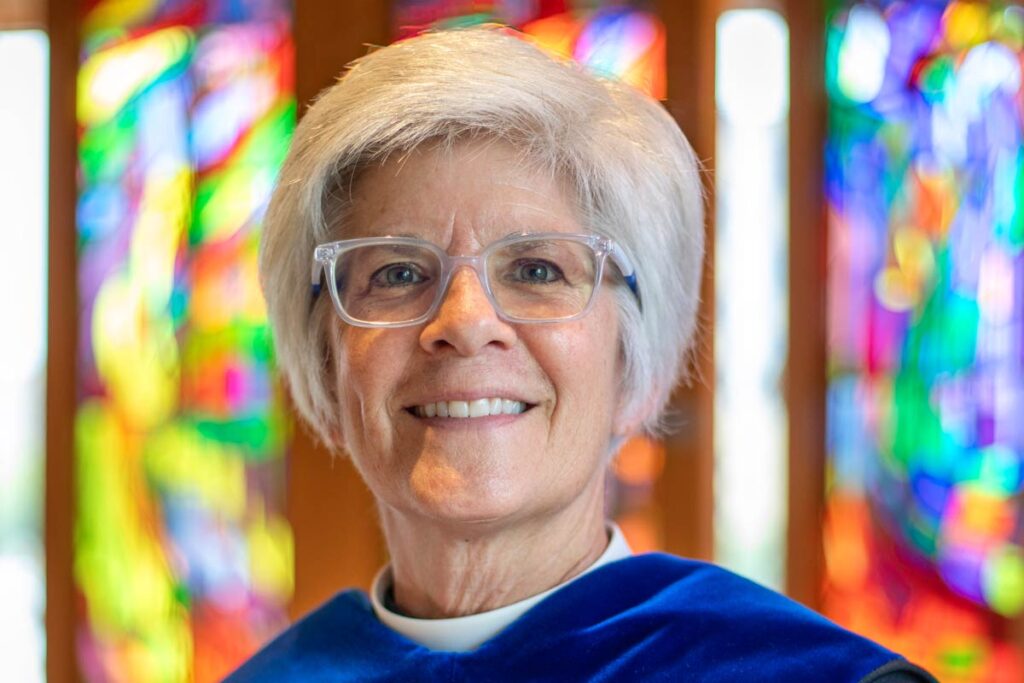
Rev. Dr. Shauna K. Hannan reflects on the theme “A Promise Fulfilled,” by centering God’s faithfulness. “For me, ‘a promise fulfilled’ immediately points me to God as the one who fulfills promises.” she says, “Our God has called us into this endeavor called theological education and says, ‘Look, you’re not on your own. I’m with you.’”
The phrase is less a slogan than it is a map: God’s nearness, a community’s work, and a future that asks us to be resilient, adaptable, and expansive. President Hannan is candid about how calls arrive. “I have had experiences in my life of calls to new things coming from outside of myself,” she says, describing the nudge that led her from a beloved faculty post into this role. “This, indeed, was another one of those external nudges…it felt like a call. Sometimes, you can get called from a call,” she says, referencing her prior role teaching preaching in Berkeley, California. When the conversations with the search committee for the presidency at LSTC made it clear “that something exciting was happening [here],” she knew she wanted to face the opportunities and challenges that come with a new position. “I wake up every morning, just really eager for the day,” she says of the early days of her new position. “And that feels just right.”
That eagerness carries an implicit charge. To talk about promise at LSTC is to talk about context, a word that threads through President Hannan’s sense of leadership and community. “We talk about the internal and the external call,” she notes. The internal summons is real. So is the church’s call, the city’s call, the world’s call—each is a context that reshapes how a seminary listens and leads.
Leadership, Community, and ‘One LSTC’
For Dr. Hannan, leadership is deeply entwined with challenges felt by so many seminaries these days. “There are multiple leadership styles, and I don’t think one leadership style aligns with one person throughout their whole lives,” President Hannan says. “We’re adaptable people, and we adapt to a context. Some situations call for a kind of transformational leadership style. I don’t think I was called to LSTC to maintain the status quo. No seminary can afford that right now, including LSTC.” Transformation, though, is not a solo sport. “We have to do this together. It’s a collective thing. It’s a collaborative thing. We need a collective buy in to make a difference. We need a team.”
That team flourishes when people work “out of their strengths,” she says—strengths that can emerge in real time as responsibility grows and “we rise to the occasion.” The operative posture: nimble, honest, willing to pivot. “Yes, I know these are buzz words. But we have to remain nimble. A leader sets a vision collaboratively, but then has a process for proceeding, and always with the possibility that we’ll need to pivot again. I want us to be able to be responsive to God’s guidance [and] the church’s needs so that it can best respond to the world’s needs.”
We want to empower people whose voices have not always been heard. I fully expect we will be delightfully surprised as a church when we broaden our understanding of who is a theological educator.
– LSTC President Shauna K. Hannan
From that posture comes a unifying frame with which to view the future, and a new way in which to work: One LSTC: Many Pathways. “People have different needs. We can do more than one thing.” she says. “This is one LSTC with multiple pathways to theological education.” For Dr. Hannan, the call of One LSTC means encouraging people to play to their strengths, asking people to adapt to a rapidly changing church and world, and encouraging all to honor the strength and power of community.
Community, in this telling, isn’t delivered from the top; it’s built by everyone. “It’ll take everyone. If people in our community want to strengthen the community, they have to be part of the process,” she says. “It’s not just one person who can make this happen.”
That insistence on shared work connects directly to considerations regarding access: questions of who can move from one location to another, how they learn, what is centered. “I think the word access is really key. Access for all,” President Hannan says. “We want people to be able to reach us. Sometimes that means going to them. Access is a very important theological theme. We know that Luther had a lot of anxiety about how to access God. But he discovered that isn’t the question. No, God already accesses us.” It is in these moments that we commit to providing access to all—whether through new learning paradigms like Project Starling or new ways of engaging potential learners—that we must also recommit to our faith and our values, even when faced with challenges to ideas we’ve previously held.
“Learning can be scary because there’s inevitably some kind of unlearning that happens first,” President Hannan says. “We don’t take a class just to get all that we know repeated. There’s a bit of an unknown—it’s risky. Learning is risky.” That risk is part of why she keeps returning to perspective—whose lens, whose life, whose story—as she considers the work of LSTC in imagining bold new futures. “The way we do things in ten years will probably not be the way we do them now,” she says. “And that’s okay. We just need to remember that.”
A Public, Expansive Future
Ask President Hannan about LSTC’s role beyond campus and she casts the horizon wide. “What role will LSTC play in the world? And why not think big?” she asks, noting deep global ties already present in faculty call stories and international students. For Dr. Hannan, LSTC’s reputation in the world means that the institution carries a heavy mantle. After all, being known as a public-church seminary could, in the wrong hands, breed complacency. “There’s a potential danger in that. We constantly need to ask, are we actually living out being a public church seminary?”
Part of the answer is leaning into expansiveness. That includes reimagining how we offer seminary education, who gets invited to have a seat at the table, who teaches, who is heard. “LSTC has been and will continue to be a place that equips people to equip others. We want to empower people whose voices have not always been heard. I fully expect we will be delightfully surprised as a church when we broaden our understanding of who is a theological educator.”
The daily fuel for a future marked by inclusion, intersectionality, justice, and diversity is close at hand, and it lives in the lives of the students who come to LSTC for theological formation. “I’m most inspired by students who’ve maybe taken a risk to leave whatever job they were hoping to have, whatever career they were hoping to have,” she says. For international students whose families bless their call from afar, the courage is communal. “I’m so inspired by that. [These students] could have done many other things in this world, and yet here they are.” Of course, the goal is for students to become alumni—to get out into the world God loves so dearly with the liberating message and work of Jesus. She wants alumni to know how proud we are of them. “We at LSTC want you, alums, to be proud of being an alum of LSTC. We want to connect with you, we want to hear from you, we want to support you in your ministries. We look forward to hearing how we can support you.”
Despite the energy, call, and purpose that President Hannan brings to her role, she understands that this is a moment that for many is one of anxieties, of fears for the future, of uncertainty in how we proceed to both honor the practical needs of the institution and the values to which we remain deeply committed. In this moment, what brings hope? For President Hannan, it is promise made practical: pathways, programs, and people aligned around a Christ-centered mission. She points to Project Starling “as a foundation for developing multiple pathways to theological education.” LSTC recommits to traditional degree seekers even as we expand access to all that we have to offer. The refrain holds: One LSTC: Many Pathways. All of it in service to the church and world we are called to love.
The final word returns to where she began: in recognizing God’s ever-faithful partnership as we respond to a changing world. “Change is both challenge and opportunity. Our church has always been reforming and that is something worth embracing.” The promise of Jesus for new life is alive and well, and the community that is LSTC is ready to walk boldly with that promise into a hopeful future.