Through the Windows on 55th Street: Phil Hougen on Learning and Leadership at LSTC
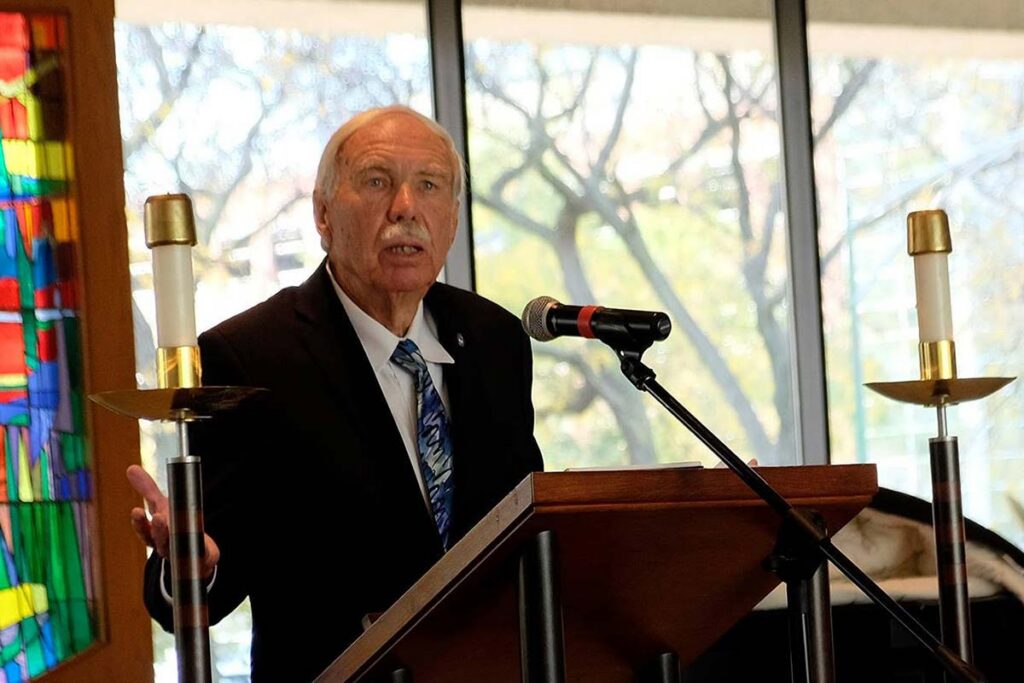
From LSTC’s earliest years in Hyde Park to his later service as bishop and president, the Rev. Phil Hougen, M.Div. ’69; DMin ’78, has spent a lifetime considering what it means for theological education to look outward.
When Phil Hougen remembers his final year as a student at LSTC, one image returns with particular clarity.
The seminary’s building, then at 1100 E. 55th St. in Chicago, was new. So was the experience of studying theology in Hyde Park.
In those days, Hougen remembers, worship took place in an auditorium-style chapel. The altar stood at the center, holding the Bible, bread and wine. Behind it were windows overlooking 55th Street.
From his seat in chapel, Hougen could look through the altar and out into Chicago.
“There was pedestrian traffic, there was car traffic, and the diversity of the community,” he recalled. For a young seminarian whose life had previously taken him from Iowa to Augustana College in Rock Island, Illinois, the view represented something much larger: “a window out onto a world I had not experienced.”
More than half a century later, that image still captures something essential for Hougen about theological education and about LSTC itself.
The church, he learned, could not be separated from the world beyond its walls.
A Seminary—and a Country—in Transition
Hougen arrived at LSTC during the institution’s formative years. After graduating from Augustana College, he began his theological education on LSTC’s Rock Island campus, the former home of Augustana Theological Seminary. LSTC had already been formed, but its new Hyde Park campus had not yet been completed.
During the 1967–68 academic year, when the Hyde Park campus opened, Hougen was completing his internship at Grace Lutheran Church in Aurora. He returned to Hyde Park for his final year and graduated in 1969.
It was, he remembers, “a time of radical change for the church and for the seminary.”
It was also a time of extraordinary change in Chicago and across the country. Hougen was finishing his internship in August 1968 when the Democratic National Convention brought political turmoil and protests to Chicago.
He and his wife drove from Aurora to Hyde Park to watch the convention with friends. Along the Dan Ryan Expressway, Hougen remembers seeing armed military personnel stationed near exits. Near the seminary, parks had become temporary encampments for National Guard and Army personnel.
“It was a bit like living in an occupied city,” he recalled.
Members of the LSTC community participated in demonstrations. Hougen attended Operation Breadbasket gatherings and remembers Jesse Jackson visiting the seminary during his senior year. The anti-war movement, civil rights struggle, political unrest and life on Chicago’s South Side all became part of the context in which students studied theology and discerned their ministries.
For Hougen, that context widened the world.
The faculty and student body were more diverse than those he had known in Rock Island, although, as he readily acknowledges, his class remained “almost exclusively white males.” International students brought experiences of Christianity beyond the United States. Faculty challenged students to understand theology in conversation with the world around them.
“It was a minor step forward,” Hougen said of the diversity he encountered. “But it was a step forward.”
And those windows behind the altar offered a daily visual reminder of what that step meant: Word and sacrament did not obscure the world outside. They provided a way of seeing it.
Phil Hougen in his own words on his life, ministry, and experiences at LSTC.
Learning to Listen
Hougen carried that broader vision into a lifetime of ministry.
He served four congregations before being elected bishop of the Southeastern Iowa Synod of the ELCA. Throughout those years, he said, his LSTC education helped him understand ministry as something larger than the life of an individual congregation.
One experience in particular deepened a lesson that had begun in Hyde Park.
In 1988, while serving St. Andrew Lutheran Church in Cedar Rapids, Iowa, Hougen attended the Democratic National Convention in Atlanta as a delegate supporting Illinois Sen. Paul Simon.
There, he listened as Jesse Jackson—whom Hougen remembered from his LSTC years—delivered one of the convention’s major speeches. Jackson spoke about Americans whose ancestors had arrived on immigrant ships and slave ships, concluding that they were now “all in the same boat.”
The arena erupted.
But one delegate, a Native American man named Ernie Whitecotton from Sioux City, IA, sitting beside Hougen, remained seated.
“Left out one more time,” Whitecotton told him.
Hougen sat down, too.
“The lesson I learned there was how hard it is to be inclusive,” he said.
For Hougen, the moment was not a repudiation of Jackson or his leadership. It was a reminder of how difficult it is for any person or institution to see beyond the limits of their own experience.
“We always have to step back and realize that someone” may still be excluded, he said.
That recognition became central to Hougen’s understanding of ministry: opening the church’s doors while remaining humble enough to recognize that welcome requires continual listening.
“There’s always a challenge that we learn how to listen to each other, how to recognize each other, how to welcome others who aren’t exactly the same as we are,” he said. “I think I learned the beginnings of that at LSTC.”
Returning to LSTC
Decades after his graduation, Hougen returned to LSTC in a very different role, serving as acting and interim president from 2011 to 2013.
The institution he encountered had changed enormously since his student days. Yet Hougen recognized both the gifts of the community and the magnitude of the challenges before it.
For a while, when people asked how things were going at LSTC, Hougen had a standard answer.
“The students are wonderful. The faculty is wonderful. And we’re broke.”
The line was honest, if perhaps not ideal for fundraising, as a colleague eventually pointed out.
Behind the humor was a serious institutional challenge. The Hyde Park campus envisioned in the 1960s had been designed with expectations of a much larger student body. Its buildings and housing were tremendous assets, but maintaining them also consumed resources that could otherwise support the seminary’s mission.
At the same time, financial support from the wider church was beginning to decline, and enrollment patterns were changing.
Some of the pressures facing theological education today, Hougen noted, were already becoming visible.
Yet he remembers the people of LSTC during those difficult years not primarily for the challenges they faced, but for their commitment to the institution.
“This was a community, represented by faculty and staff and administration, that really wanted to make things work at LSTC,” he said.
Hougen sees his own presidency in similarly communal terms. He describes himself as a bridge between two leaders who shaped LSTC in distinct ways: the Rev. Dr. James Kenneth Echols, the first African American president of an ELCA seminary, and the Rev. Dr. James Nieman.
Echols, Hougen said, “was a very significant leader in theological education in the ELCA,” who brought his own gifts to LSTC. Nieman, in turn, brought “unique gifts of leadership” and a deep knowledge of theological education.
“I was a small part of it,” Hougen said of the transition between them, “and I was honored to be.”
What the Name Asks of Us
Ask Hougen what remains distinctive about LSTC today, and his answer begins with something deceptively simple: its name.
The Lutheran School of Theology at Chicago.
Each part, he believes, represents both an identity and an ongoing calling.
To be Lutheran is to continue offering a Lutheran witness within the wider Christian community, particularly the proclamation of salvation by grace through faith, while being “radically ecumenical and radically interreligious” in relationship with others.
To be a school is to educate students and prepare leaders capable of articulating Christian faith thoughtfully and rigorously, including to people who do not share the same religious background.
To be a school of theology is to remember that theology is more than an academic discipline.
“It’s a word about God,” Hougen said.
And then there is Chicago.
LSTC’s location on the South Side places it within a dynamic, diverse community that continually challenges the institution to encounter experiences beyond its own.
For Hougen, those commitments are inseparable.
“I think the challenges for LSTC are what they’ve always been, and they’re encapsulated in its name,” he said. “We’re called to be Lutheran. I think we’re called to be a school. I think we’re called to be a school of theology, and I think we’re called to do that in the context of the South Side of Chicago.”
Still Looking Outward
Hougen’s advice for today’s students begins with taking vocation seriously: recognizing a call to ministry as both a call from God and a call discerned through the church.
But he also encourages students to embrace the community that theological education can provide.
“LSTC can be a place where we can be accepted as we are,” Hougen said.
The challenge is to keep creating that kind of community: one where people bring their gifts, experiences and differences into relationship, then carry what they have learned into the church and the wider world.