Bearing Witness in the Academy: LSTC Doctoral Students at AAR/SBL
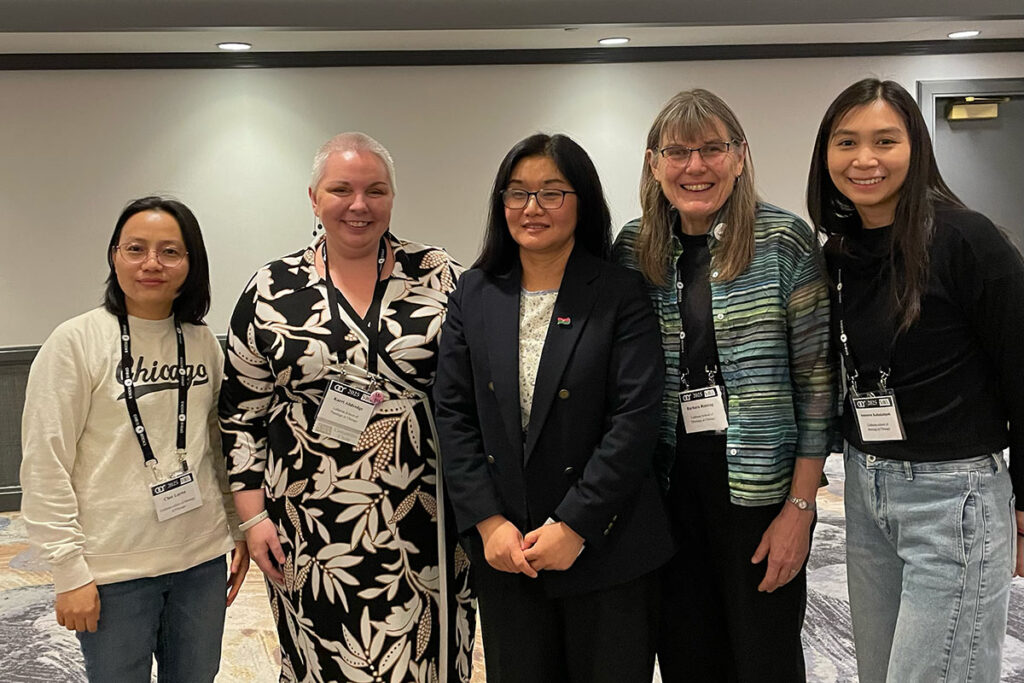
Each year, the American Academy of Religion and Society of Biblical Literature Annual Meeting (AAR/SBL) gathers thousands of scholars from around the world to share research at the forefront of religious studies, biblical scholarship, and public theology. To present at AAR/SBL is a significant milestone for any scholar. This year, four Advanced Studies students from the Lutheran School of Theology at Chicago, Martha Ambarangu, Maran Seng Tsin Nan, Char Laywa, and Dax Mathew, stepped into that global scholarly space with confidence and clarity. Their work, shaped by rigorous academic inquiry and grounded in lived experience, faith commitments, and urgent questions of justice, reflected LSTC’s distinctive approach to theological education.
From Assistant Professor of New Testament Karri Alldredge’s perspective, the strong presence of LSTC students at the conference signals both the vitality and the purpose of the school’s doctoral formation. “Having so many of our students presenting speaks to the quality of LSTC’s Advanced Studies program and the cutting-edge research of our students,” she explains. “Their work is contextualized and timely, responding to needs of their communities of accountability.” She adds, “From developing new forms of contextualized biblical criticism to exploring forms of political resistance, our students are equipping their communities with tools to address injustice and glimpse the kin-dom of God.”
Maran’s presentation, “Rereading Hypomonē (ὑπομονή) in the Book of Revelation as Enduring Resistance for the Kachin Concept of Resistance in Myanmar,” emerged from deeply personal and pastoral concern. Drawing on her experience as a theological educator in Myanmar, Maran’s research responds to the ongoing injustice faced by the Kachin people under military dictatorship. In her paper, she reexamines the concept of hypomonē—often translated as “patience” or “endurance”—in the Book of Revelation. Rather than framing it as passive suffering, Maran interprets hypomonē as a form of active, nonviolent resistance.
She connects this biblical framework to the Kachin concept of “Shakut Sharang let Gumlau ai,” or “enduring rebellion,” offering churches in Myanmar a theologically grounded vision of resistance that is faithful, courageous, and life-giving. “My research engages with the Kachin churches in Myanmar, which have resisted the dictatorship for many decades. These churches have endured oppression, injustice, and poverty as a result of the civil war and an unjust system of governance. This study seeks to offer them comfort and biblical guidance from the book of Revelation to strengthen their journey toward faithful and victorious resistance.”
Alldredge situates Maran’s work squarely within LSTC’s public church commitments, noting that she “is addressing oppression of the Kachin Christians in Myanmar through an exploration of Revelation.”
At AAR/SBL, the engaged questions and thoughtful dialogue that followed Maran’s presentation affirmed that her work resonates beyond its immediate context. The conversation demonstrated that scholarship rooted in local realities can speak powerfully to global audiences while remaining accountable to the communities that inspire it.
Mathew’s presentation similarly bridges historical research and contemporary concerns. His paper, “Contested Ideas of Freedom: Indian Christians Challenging the Social Caste System through the Writ of Habeas Corpus,” examines a nineteenth-century civil lawsuit in British-controlled western India. In the case, Protestant Indian Christians asserted their right to access public water wells—a right denied to Dalit communities under the caste system. Known in missionary archives as the “Water Trouble” case, the lawsuit reveals how marginalized Christians strategically used colonial legal systems to challenge deeply entrenched social hierarchies.
Mathew situates these petitions as what historian Paul Halliday describes as the “sighing of the prisoner”—a biblical and moral cry for justice echoed through legal form. His work is shaped by both archival inquiry and ministry engagement, including his experience working with Adivasi (tribal) communities whose cosmology emphasizes the interconnectedness of water (jal), land (jamin), and forests (jangal). Through this lens, Dax’s research highlights alternative visions of freedom and human rights rooted in collective well-being rather than individualism, adding new texture to the historiography of Indian resistance movements that predate mass mobilizations like the Mahad Satyagraha of 1927.
Presenting alongside scholars working in diverse global contexts, Mathew found affirmation in discovering shared questions approached through different analytical frameworks. “When senior scholars engage your work seriously,” he reflects, “you realize you are part of a larger scholarly community wrestling with the same urgent questions.”
For Alldredge, the work of LSTC’s graduate students reflects LSTC’s broader commitments as a public church institution. “The work of these students is an embodiment of LSTC’s public church commitments,” she says. “Not only are they creating scholarship that has direct impacts on their congregations and communities, they are introducing new justice-centered ways of engaging texts and traditions to the global academy and beyond.” She further notes, “They are challenging the white, male, Euro-American dominance of the academy, ushering in intersectional, contextualized scholarship.”
Participation in a conference like AAR/SBL, Alldredge explains, plays a formative role in shaping students as scholars, teachers, and leaders. “Presenting a paper at AAR/SBL brings your scholarship to a global community. It offers opportunities to gain insights and perspectives from a wide range of scholars and leaders.” She adds, “Participation also affirms the importance of the work they are engaging in. It asks them to claim their authority as scholars and invites them to enter into shaping the future of theological scholarship and education.”
The response to the students’ work underscored that formation. “Their work was well received,” Alldredge observes. “Many were grateful for their contextualized scholarship. People were interested in how it would concretely impact their communities.”
For Maran and Mathew, the conference marked more than a professional milestone. It was a moment of recognition that scholarship grounded in faith, justice, and lived realities belongs both in the academy and in the life of the church. As Maran encourages other emerging scholars, “Take the opportunity to present [your] work when you are ready… presenting a paper offers valuable insights that strengthen one’s writing and contribute meaningfully to one’s overall academic development”
Looking ahead, Alldredge sees this moment as emblematic of LSTC’s future. “To have this many students present at AAR/SBL is a testament to the vibrancy and importance of LSTC’s doctoral program,” she says. “LSTC’s commitment to shaping global scholars is unique and urgently needed for the church and academy.” Reflecting on conversations with accrediting organizations and peers at the conference, she adds, “They had great interest and hope in LSTC’s doctoral program. This program needs to be supported financially so that it can serve as a model for theological education.”