Congressional Candidate and Alum Sarah Trone Garriott on the Power of Showing Up

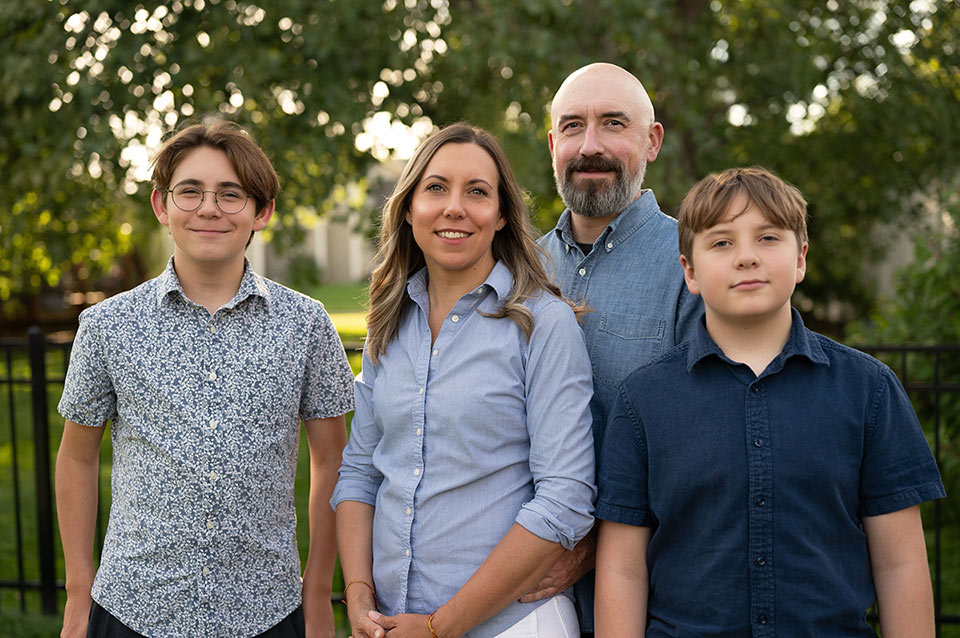
“When I was a chaplain at Children’s Memorial Hospital, I would spend the night walking the hallways,” says Sarah Trone Garriott, MDiv ’08 and Iowa State Senator.
It was in those spaces that she would encounter the parents who couldn’t sleep, the children who were afraid, the babies who needed rocking. As a stranger, she encountered people on the worst days of their lives and committed to being present with them. “That’s how you serve a community,” she says. “You’re present.” She learned that one of the most important and most impactful parts of her role was simply showing up. For Trone Garriott, the chaplaincy axiom “Don’t just do something, stand there!” has served her well. “It was about being present so that you could do something,” she explains. “You could do the thing that was needed in the moment. And now, as a state legislator, it’s again about being present for my community.”
The Journey to IA-03
The road to Sarah Trone Garriott’s current position as a congressional candidate running to flip IA-03 has been one that has been marked by her work in ministry as well as her commitment to service.
From Trone Garriott’s experience as an AmeriCorps VISTA Volunteer, to her experience working with Des Moines’ largest Food Pantry Network, to her ongoing work in ministry, she is committed to bringing people together to find common ground and to meet people where they are.
“There’s always opportunities to connect,” Trone Garriott says. “And there’s always common ground. We have differences. They are real, they are significant, they matter. But we also have things in common.”
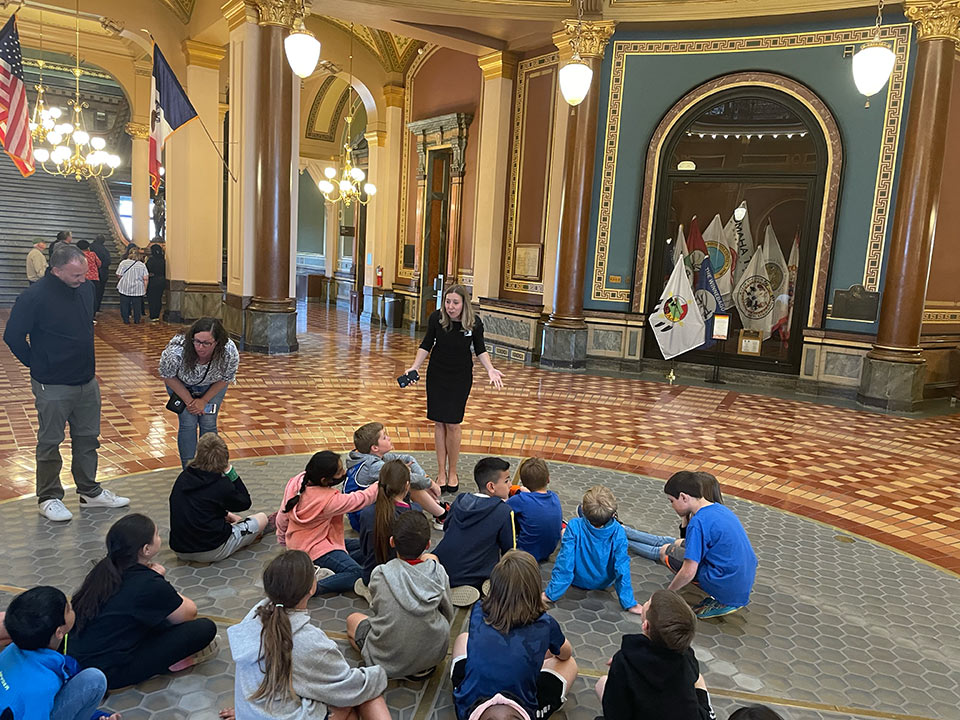
For Trone Garriott, those commonalities often start with the prayer on the floor of the Iowa State Senate. “I invite religious leaders from my community to write prayers that I share on the Senate floor,” Trone Garriott notes. “And then I’ll invite [the contributors] to be there, so that I can acknowledge them and say a little bit about who’s providing the prayers. And it’s a pretty diverse community. I’ve offered prayers for my Muslim neighbors and Jewish and Sikh and Hindu and atheists and the whole spectrum of Christianity. I think it’s important to remind my colleagues that this is Iowa.” For Trone Garriott, practicing pluralism and sharing prayers from many contexts into public spaces speaks to her values of promoting intersectionality, diversity, and connection.
That model of leadership stems from her work in parish life. In her first call, for example, when she served a rural congregation in Virginia, Trone Garriott took the church directory and visited every member where they lived to learn the community from the inside.
“Ministry is really about showing up,” she says again.
That core belief—that being in community, in conversation, and in shared experience with others—separates Trone Garriott from many other leaders in civic spaces. In fact, Trone Garriott believes it’s one of the reasons she has been consistently successful in difficult districts that were often labeled as Republican-leaning by Democrats.



Being the Change
“Politics,” she explains frankly, “is 95% vibes.” By that she doesn’t mean spin. She means relationship. Understanding. “You’re not there to convince people of issues,” she says. “You’re there to connect with them. So, when I’m out there, I’m trying to communicate that I’m a person who cares, who works hard, who’s going to show up, who’s going to listen. You can’t fake that.”
Trone Garriott’s earnestness resonates in districts that have long voted red. Even when the margins are slim, her community knows that she is there for them.
One benefit, for Trone Garriott, is her continued commitment to preaching on the weekends. “I preach anywhere I get invited,” she says candidly. “Anywhere they’ll have a lady pastor in the pulpit.” Her work in ministry has given her unique insights into the issues everyday people are grappling with in difficult political times.
She recalls one day this past spring, while filling in at a Lutheran church on the South Side, when she encountered a congregant in distress. He was experiencing grief over a friendship that had ended after the 2024 election. The congregant’s friend, angry that the congregant had voted for President Trump, stopped speaking to him entirely.
“He ended the conversation saying, ‘Well, I’ll just keep praying that one of us changes,’” Trone Garriott recalls.
Her response was at once pastoral and unsparing: “You both probably will have to.”
Participation over Despair
For Trone Garriott, bringing people together means looking unflinchingly at what must be placed aside so that we can move forward together. Legislatively, that often means fighting against the power of personality differences to privilege legislative priorities that will meet the basic needs of most of her constituents. For Trone Garriott, these priorities reflect her vocational history. After nine years working with food pantries, she is deeply focused on food insecurity and poverty. As a former chaplain, she understands the intersection of health, mental health, and policy. In the Iowa Senate, she serves as the ranking Democrat on Health and Human Services and sits on the Education Committee.
But she returns, again and again, to something less tangible: belonging.
“Belonging, or connection, really is the thing that people are needing the most in this time,” she says. “And that is driving a lot of political behavior.”
When people feel disconnected, anger can offer a sense of belonging. It draws clear lines between who is in and who is out. Trone Garriott sees that dynamic at work across the political landscape. She also sees how easily despair takes root.
“I always feel like our greatest opponent in politics is despair,” she says.
Her antidote is not grandiosity, but participation. Trone Garriott reminds young people that local elections are often decided by razor-thin margins. “The lie that people are told is, you don’t matter and you can’t fix things and you can’t change things,” she says. In fact, the opposite is true, and she is living proof: Trone Garriott won her last race by twenty-nine votes. She recalls that a congressional race in Iowa was once decided by six votes.
Embodying the Word for the Sake of the World
As Trone Garriott runs for Congress, the lessons she carries from LSTC are not abstract. They are embodied practices.
She names former Professor of Homiletics Craig Satterlee as formative without hesitation. She credits Professor emeritus of New Testament David Rhoads with reshaping her understanding of scripture through performance and memorization. “[Because of him], for the last seventeen years, every time I’ve preached, I’ve memorized the scripture and proclaimed it from heart,” she says.
That discipline, she explains, is not only about technique. “It’s about making the world word flesh. And that’s foundational to how I think about being faithful. That’s my number one job in preaching and learning and serving: making the word flesh.” In that way, public service is not a departure from ministry. It is its expansion.
“My ministry just got so much bigger once I left the parish in 2017 and went into the nonprofit world,” she says. She jokes that she is now “everyone’s favorite Lutheran minister,” working across communities that include atheists, Muslims, and members of the Church of Jesus Christ of Latter-day Saints.
The call, she insists, has never changed. Only the context has.
As Trone Garriott steps onto the national stage, recently named to the Democratic Congressional Campaign Committee’s Red-to-Blue program, she remains clear-eyed about the work ahead. The designation signals that her race is among the most competitive in the country, and that national resources will follow. It also comes after years of having to prove herself. Still, recognition matters, especially in a state like Iowa. And she knows what she brings. Not a set of talking points, but a way of being with people. A refusal to write anyone off. A belief that presence is political.
For students and alumni discerning how to connect faith with public leadership, her counsel is expansive. Ministry does not belong only in sanctuaries. It belongs wherever people are hungry, sick, excluded, or unheard. It belongs in nonprofit offices, in city halls, and in legislatures. “That means following Jesus,” Trone Garriott says. “Well, what is Jesus doing? He’s feeding the hungry, and caring for the sick, and welcoming the stranger, and protecting the vulnerable, and criticizing the wealthy and the religious know-it-alls. And I think there’s so much need right now for that kind of leadership.”
And it begins, as it always has for her, by showing up.