How CCME Promotes Interfaith Engagement to Foster Understanding
For Sara Trumm, education and engagement go hand in hand.
Trumm currently serves as Director of A Center of Christan-Muslim Engagement for Peace and Justice (CCME) at LSTC. Founded in 2006, CCME fosters and deepens relations between Christians and Muslims as a significant part of its broader mission to build bridges of mutual understanding, respect, and cooperation among people of all faiths.
“To me, ‘engagement’ is the key word in our organization’s title,” Trumm says.
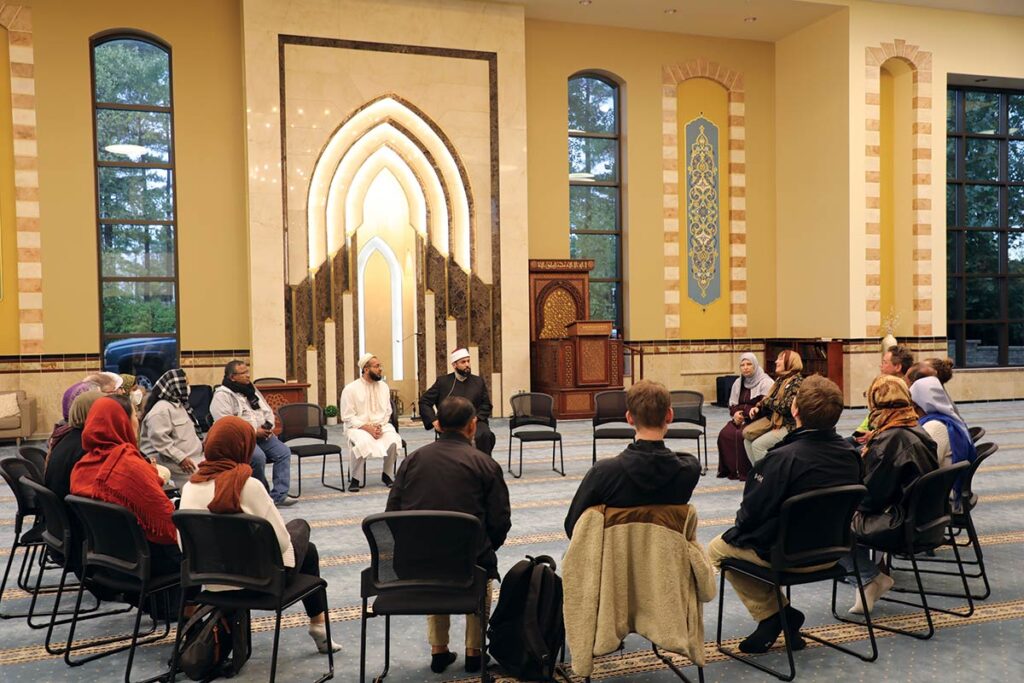
CCME hosts a wide range of activities throughout the year, reaching out to people of different faiths both online and in person and creating opportunities for them to get to know and learn from one another. From mosque visits and interreligious dialogues to an annual Giving Thanks Feast, Trumm has a front-row seat to the power and impact of interfaith experiences.
“Even going to a mosque and watching prayer can spark someone saying, ‘Wow, that commitment to praying five times a day is so amazing and beautiful,’” Trumm says.
To plan activities for the fall semester this year, Trumm asked students what they wanted to learn, and what types of experiences they most wanted to have. They expressed particular interest in sitting down to talk with people from other faith traditions.
In accordance with that request, this fall CCME is offering many such engagement and learning opportunities. During the annual Kristallnacht Service of Remembrance in nearly November—led by a rabbi and cantor from a local synagogue, with members of the Jewish community in attendance—participants acknowledge Martin Luther’s “anti-Judaic diatribes and the violent recommendations of his later writings against the Jews,” as described in A Declaration of the Evangelical Lutheran Church in America to the Jewish Community. That declaration was adopted by the Church Council of the Evangelical Lutheran Church in America in 1994, and a revised version was adopted by the Church Council in 2021 as a reaffirmation.
“This is always a very powerful event and an important opportunity for us to evaluate our involvement or noninvolvement [in speaking out and standing up for marginalized people],” Trumm says.
Alongside that acknowledgement of the past, CCME is working to build a better future through a program on preaching Jesus with interfaith sensitivity, tailored primarily to the Jewish community. There are some texts pastors may be asked to preach on that can be hurtful to the Jewish community, Trumm notes, playing into stereotypes without even realizing it. The goal of the interfaith sensitivity program is to raise awareness about those issues while also highlighting texts that bring communities together through their shared histories and values.
The different types of events and conversations CCME offers give seminarians opportunities to connect one-on-one, to go deep in their dialogue—and to advance at their own pace.
“There’s so much for our seminarians to try and juggle and sort through,” Trumm says. “Some of them have very little involvement or knowledge about any interfaith communities. Some have come from contexts where interfaith relations are a feature of daily life. So, we don’t approach programming with a one-size-fits-all mindset. We strive to reach people where they are, so we can move forward together.”