“I’ve Learned that God is Rarely Early, but Never Late:” LSTC Alum John Kotovsky MDiv ‘98 on Philanthropic Giving and the Future of the Church

When John Kotovsky walked into the partner’s office at Arthur Andersen and declared, “I quit,” he didn’t have another job lined up. What he did have was faith that something better was ahead. After five and a half years on track to partnership, averaging between 400 and 600 hours of overtime each year, the toys of success no longer held meaning. “I would leave in the morning before my wife was up and come home at night after she was already asleep,” Kotovsky said. “That takes a toll on you.”
That decisive moment set Kotovsky on a winding journey through business, ministry, and nonprofit leadership; one marked by hard work, resilience, and faith in God’s timing. “I’ve learned that God is rarely early, but never late,” he said. “There are moments when I thought, ‘How is this going to work?’ And at 11:59, something always came through.”
Today, Kotovsky is not only known for his success in business, congregational leadership, and senior services, but also as a generous philanthropist whose commitment to LSTC reflects a conviction that giving is both obligation and joy. His story is not simply about professional success, it is about living into a faith-filled calling and ensuring that future generations have the chance to do the same.
A Life Shaped by Call and Service
Kotovsky’s connection to the Lutheran church runs deep. As a high school youth in St. Louis, he witnessed the trauma of the Concordia Seminary walkout and the birth of Seminex. “That planted a lot of seeds in me,” he recalled. Later, as district Luther League president, he traveled to Tanzania as a delegate to the Lutheran World Federation Assembly, an experience that gave him, as he said, “a much broader understanding of the greater Lutheran church.”
When he sensed a mid-life calling to ministry, Kotovsky was mentored by Rev. Ron Glusenkamp, a Seminex grad and his pastor. Kotovsky also studied under Robert W. Bertram, Frederick William Danker, and other Seminex professors teaching in St. Louis. Eventually, Kotovsky’s candidacy committee required him to spend a year at a Lutheran seminary, and LSTC, with faculty he already admired, was the natural choice. “It was great. I felt very blessed by it,” he said.
By then, Kotovsky had already established himself in business. After leaving Arthur Andersen, he served as CFO for a large family-owned real estate development company. “I learned how to look at a deal, understand the essence, and set aside what didn’t matter. It created a nest egg, and when I sensed a calling to seminary, that was my safety net. I could provide for my wife and three children.”
That sense of provision carried through his time in parish ministry and later leadership roles. At Community Church of Joy in Arizona, an 11,000-member congregation, he helped steward a multi-million dollar budget that frequently relied on last-minute provision. “At 11:59, we’d get a million-dollar gift,” he remembered of tight deadlines and the anxieties of managing an operational budget that was routinely about one million dollars short of what the congregation needed to thrive.
Eventually, his path led back to St. Louis, where he became CEO of Lutheran Senior Services, then the 14th largest nonprofit in the United States. Yet even as he led large organizations, Kotovsky never lost his philosophy of servant leadership. “One day a year, I’d go into the communities and do whatever staff wanted…the story of my first job, starting out as a dishwasher, was legendary. Later, my message was always, no job is more important or less important. We are a team.”
For Kotovsky, leadership was never about hierarchy but about dignity. “Serving others was my witness of faith. That’s what we all should be doing.”
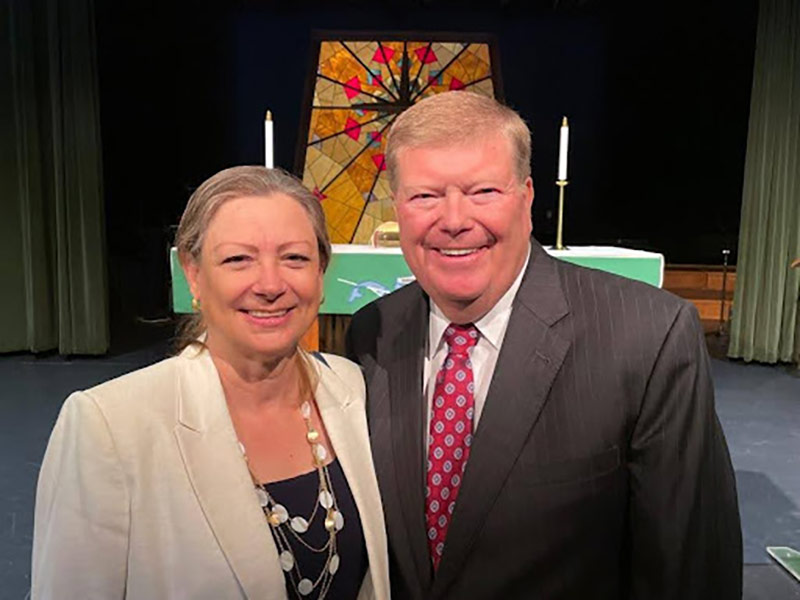
Giving as Faith, Obligation, and Legacy
Kotovsky’s generosity toward LSTC is rooted in a deeply personal theology of stewardship. “When I was younger, I used to worry a lot about money. God always got the leftovers. But when my wife, Elaine, and I became tithers—giving away the first 10 percent of our income—we never worried again. From that day forward, I can tell you, we have had manna-in-the-desert stories.”
He grew up with very little. “My father was a taxicab driver. I didn’t own a new pair of jeans until I was 17. We were poor, but my mom always reminded us that God is a God of abundance, not scarcity. I like to say God is the ultimate Hamburger Helper—he’s a multiplier of blessings.”
That perspective informs his philanthropy today. “God has blessed me for a reason, and it’s to make a difference in relationships, in supporting people, in financially giving back to the things that matter,” he said. “If you want to know where God stands in your life, look at your checkbook and your calendar. Where your money goes and where your time goes, that’s your faith.”
Kotovsky is particularly inspired by LSTC’s Project Starling, which he sees as vital to preparing future leaders. “The greatest challenge in the church today is leadership. Too often, we prepare people to be chaplains rather than evangelists. I like Project Starling because it recognizes that pastors also need to be CEOs and CFOs. They need experiential learning. If seminaries can revamp how they prepare women and men for ministry, the church can have a renaissance.”
His vision of legacy is anchored in faith. “I think of myself as an ancestor now. What do I want to leave behind? What is the significance of that dash between birth and death on headstones in a cemetery? For me, it’s not about being remembered for what I’ve done, but what can be passed on to others: faith, leadership, resources that help people grow God’s kingdom.”
Kotovsky knows this work matters because he’s seen God’s hand in every step of his life: from his early years when he met his wife in a Lutheran nursing home when he worked in the kitchen and she worked as a nurse’s aide, to leading one of the nation’s largest nonprofits senior living organizations. “People say God doesn’t have a plan for your life. I can tell you every single step of my life, God has been molding and preparing me according to his plan.”
And to fellow alumni and friends of LSTC, his message is clear: “If you knew the true cost of your education, you’d realize you were standing on the shoulders of others who gave. You have an obligation, a responsibility, to do the same for the next generation.”