November 2025 Board Highlights: Presidential Transition, Institutional Strength, and Strategic Momentum at LSTC
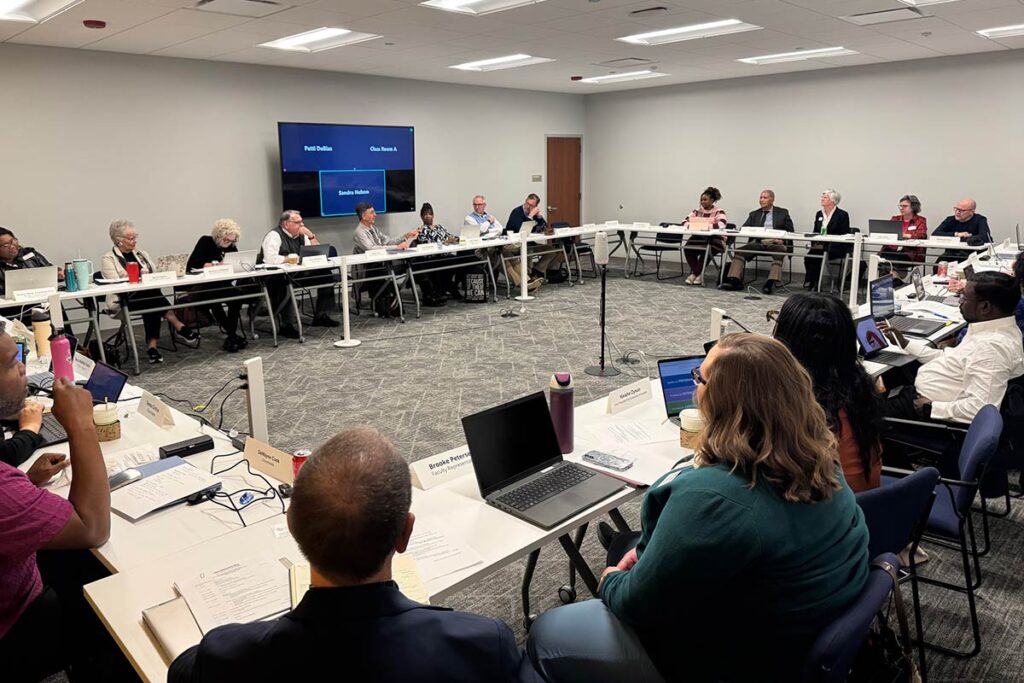
The November 2025 meeting of the Board of Directors of the Lutheran School of Theology at Chicago, held November 13–14, coincided with a historic moment in the seminary’s life—the inauguration of President Rev. Dr. Shauna Hannan and the public launch of a new era of mission-driven innovation. Gathering on the eve of the inauguration and the LSTC Seminary Showcase, the Board’s fall meeting underscored continuity and confidence across governance, finances, and strategic priorities, affirming LSTC’s steady progress toward institutional sustainability and its mission to form leaders for the church and world in a time of profound change.
Guided by Vision: Presidential Inauguration and Mission Alignment
The meeting opened in prayer and gratitude for this new chapter in leadership. The Board installed new board members including Theresa Cintrón, Tony Johnston, Bishop Becca Middeke-Conlin, new faculty advisors Rafael Malpica Padilla and Brooke Petersen, and welcomed new student representatives Martha Ambarangu, Immanuel Karunakaran, and Rajesh Kumar Jayaraj.
Following their installation and a collaborative Bible study, President Hannan offered her inaugural report, situating the seminary’s work within LSTC’s mission to form leaders for a changing church and world. She highlighted the remarkable progress of the past four and a half months, including the sale of three apartment buildings, the institution’s continued commitment to the safety and security of international students, and a reaffirmation of LSTC’s commitment to increasing the number of learners in its enrollment funnels.
President Hannan also identified areas of opportunity in developing new systems for learners currently in the institutional pipeline and affirmed a continued commitment to dedicated staffing to support enrollment.
She celebrated recent fundraising achievements made possible by the Advancement team and faculty experts and announced the receipt of a $1 million Lilly Grant written by Dr. Christian Scharen. Dr. Scharen, contributing to the President’s report, emphasized that the grant—grounded in iterative listening and creative program design—will strengthen LSTC’s engagement with communities on the margins of the ELCA.
President Hannan closed her report by underscoring the need for continued attention to reducing overall staffing costs and promoting deeper integration across academic life and public witness, digital innovation and in-person formation, and local partnerships and global reach.
Marketing and Fundraising
The Marketing and Fundraising Committee reported on strategic initiative work supporting the One LSTC: Many Pathways approach: from silos to synergy. Vice President for Advancement Sandra Nelson announced the successful completion of Phase I of the Time to Re-Imagine, Re-Invent, Reaffirm, and Re-New campaign. To date, including the Lilly grant, Advancement has raised $9,065,232 from 1,442 donors—exceeding the initial goal by more than $1,077,000—with $4,387,176 in unrestricted gifts. Of this total, more than $1,400,000 was donated to scholarships, underscoring strong community commitment to LSTC’s long-term sustainability. Nelson also announced Phase II, a two-year campaign initiative concluding December 31, 2027, led by Christie and Larry Tietjen and assisted by Harry Mueller and Sarah Stegemoeller. Board member Maryjeanne Schaffmeyer reported on the need for updated shared metrics to support continued institutional advancement; this work will be stewarded by the Executive Committee.
The Office of Marketing and Communications presented updates on narrative strategy as formation, expanded reach and public witness, and the launch of a learner-centered admissions campaign, “Made for This,” designed to speak to prospective learners and degree seekers across the LSTC ecosystem.
Governance Committee
Board Member Joseph Falese reported on a new orientation session for advisory and student representatives, enhancements to Board evaluation practices following each meeting, and the Governance Committee’s ongoing commitment to strengthening Board effectiveness. The Committee reviewed and affirmed the revised Marketing and Fundraising Committee Charter and began planning for the upcoming 2026 Board member succession cycle.
Strategic Plan Initiatives
Director of Human Resources and IX Director Aaron Copley-Spivey provided an update on Strategic Plan Initiatives titled On the Way… scheduled for 2024–2029. The plan’s four core areas—Asynchronous Education, Philanthropic Campaign, Policy Review, and Staffing Strategy—continue to advance. Copley-Spivey reported strong outcomes in Project Starling enrollment and highlighted the partnership with the ELCA Innovation Lab led by LSTC Vice President of Innovation Keisha Dyson. He noted Phase I philanthropic success and ongoing work under LSTC’s Policy Review, including faculty revisions to the Faculty Handbook, Implementation Team policy revisions, and an updated Staff and Administrative Personnel Handbook published at the beginning of the year.
Under Staffing Strategy, Copley-Spivey affirmed successful reductions in compensation spending, implementation of programs to increase staff capacity, and the executive cabinet’s participation in the Evolving to Exceptional leadership development program. He also reported on updated annual benchmarks and ongoing development of standard operating procedures for Major Gift Portfolio Review, new donor processes, Synod/Church/Alumni Engagement strategies, and a Donor Survey.
Fiscal Stewardship and Housing Review
The Finance and Operations Committee reported a strong FY2025 financial close and continued advancement toward long-term sustainability. Discussion emphasized maintaining a balanced FY2026 budget, prudent management of endowment draws, and the successful strategic sale of underutilized buildings. The Committee also updated the Board on efforts to right-size student housing in response to enrollment demand and a favorable housing market. In addition to the three recent building sales, this work includes a three-year lease-back of the “yellow building” to ensure continued accommodations for learners. The Committee recommended the formation of a new Housing Task Force to help the Board proactively manage future student housing needs and affirmed the ongoing need to update metrics to support clear and informed decision-making. These conversations reflect LSTC’s commitment to aligning assets with mission while ensuring student well-being and long-term institutional stability.
Strategic Innovation and Digital Expansion
Vice President for Enterprise Innovation Keisha Dyson provided updates on Project Starling, LSTC’s asynchronous digital learning platform, highlighting its expanding role in flexible formation for TEEM, SAM, and independent learners. Dyson incorporated reflections from current participants, including Noreen Stevens of the Northern Great Lakes Synod, demonstrating how the platform supports expanded access, vocational discernment, and leadership pathways across the church. Project Starling continues to grow donor support and faculty engagement and will soon include development of an LDA (Lutheran Deaconess Association) Deaconess Certificate, CEU courses for consecrated leaders, and future co-branded workshops in Womanist Theology and LGBTQIA+ Theology. Dyson closed by highlighting the success of current user-testing cohorts and reaffirming LSTC’s commitment to strengthening synodical relationships as Starling expands.
Enrollment Outlook and Admissions Updates
Interim Director of Admissions and Advisor for Enrollment Strategies Cindy Sisson provided updates on admissions, staffing, enrollment, and curriculum. She introduced LSTC’s new Admissions Counselor, Cade Chrastina, who brings a deep commitment to LSTC’s mission and will play a key role in strengthening enrollment. Sisson outlined recommendations for additional strategic leadership, increased CRM optimization, an expanded admissions marketing budget, and a restructuring of financial aid resources for incoming students. While Fall 2025 commitments remain below goal, new digital engagement strategies and strengthened synod partnerships are expected to enhance future enrollment cycles.
DEIJ and Reparative Justice Commitments
Marvis Hardy presented updates on reparations and restorative justice work, including LSTC’s new Reparations Clearinghouse Initiative, modeled on the National Clearinghouse for Civil Rights Litigation, to resource theological reflection and partnership. The initiative will include development of a new academic course and digital infrastructure to support archiving and access to documents and resources. This work will continue into 2026, advancing LSTC’s public commitment to repair and reconciliation. Director of Diversity, Equity, Inclusion, and Justice Vima Couvertier-Cruz facilitated an Intercultural Development Inventory (IDI) debrief session for the Board, building on May’s orientation and supporting ongoing intercultural learning and inclusive leadership.
Candidacy Update
Brooke Petersen, John H. Tietjen Chair of Pastoral Ministry; Associate Professor of Pastoral Care; Director of the MDiv, MA, and MAM Programs; and Director of ELCA Candidacy, presented an update on the candidacy process following the ELCA’s implementation of a new first-call process in 2021. In 2022, the ELCA formed a candidacy working group to reimagine the overall process and address long-standing challenges experienced by students. That work has now produced draft recommendations outlining potential evolved pathways for students entering the LSTC ecosystem.
The ELCA’s draft proposals include introducing new core competency areas to guide students through candidacy, incorporating student portfolios into candidacy qualifications, and establishing updated endorsement procedures for seminaries. Additional recommendations include annual check-ins between students and their candidacy committees. The ELCA is also exploring more customizable degree pathways, which may involve contextual and curricular implications. Throughout this discernment, ELCA leadership has emphasized a commitment to consistency across seminaries and to strengthening collaboration rather than competition. As these recommendations move toward formal review, LSTC remains committed to a responsive and adaptable approach to curricular updates and to deepening partnership between the Office of Contextual Education and the Candidacy Office. LSTC is currently in the pilot phase, with full implementation anticipated for late spring or summer 2028.
Action on En Bloc Items and Executive Session
The Board unanimously approved all items in the en bloc resolution package. This included formal approval of the Cross Functional Housing Task Force, charged with exploring future models of housing and community support. The Task Force will include representation from students, admissions, faculty, executive staff, and the Board, with leadership appointed by President Hannan and Chair Lewis. It will revisit the Shared Values, develop a new charter and project plan, and report progress to the Board, including identifying members and objectives by February 2026 and providing preliminary projections on student housing needs by May 2026.
The Board also approved recommendations from the Governance, Academics and Community, and Finance and Operations Committees. These actions included the approval of the following: the revised Marketing and Fundraising Committee Charter, the sabbatical proposal for Professor Karri Alldredge (July 1–December 31, 2026), and delegation of authority to the Finance and Operations Committee—with counsel from the administration—to approve the Fiscal Year 2027 Tuition and Fee Schedule and Housing Fee Schedule, both due for publication by January 31, 2026. The Committee was also delegated responsibility to approve the calendar year 2026 clergy housing allowances for ordained faculty and staff.
Finally, the Board reaffirmed its annual authorization of signers for LSTC’s banking, investment, and financial agreements. LSTC’s Secretary is authorized to renew the approved slate of officers as signers, with staff reviewing current practices and recommending updates prior to the next renewal. Authorized signers include the President; Vice President for Finance and Operations; Vice President for Advancement; Dean and Vice President of Academic Affairs; Vice President for Enterprise Innovation; and Treasurer.
Looking Ahead: Confidence Through Change
The November 2025 Board of Directors meeting marked both a culmination and a beginning—a moment of gratitude for the leadership that brought LSTC to this point and confidence in the path ahead. With President Hannan’s inauguration, a balanced budget in view, and strategic initiatives such as Project Starling advancing, LSTC continues to embody its mission of forming public church leaders for a world in need of courageous, compassionate faith.