Spring 2026 Board of Directors Meeting: One LSTC Moving Towards Synergy
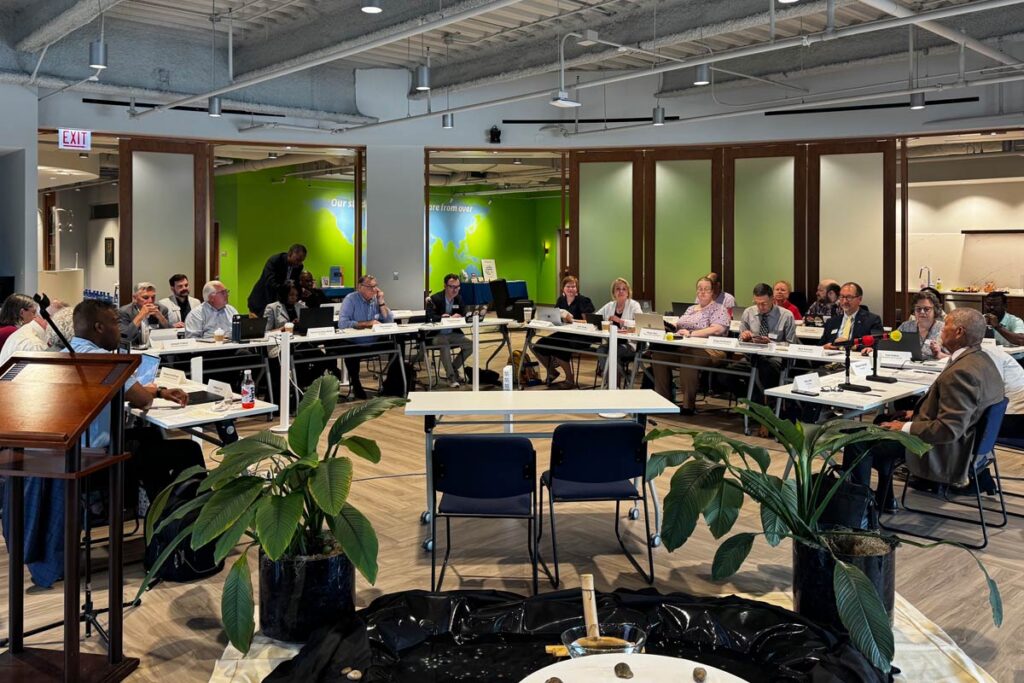
The Spring 2026 meeting of the Board of Directors of the Lutheran School of Theology at Chicago opened on May 18 with Board Chair Greg Lewis calling the meeting to order, followed by an opening devotion offered by Board Member Rev. Preston Fields. Throughout the meeting, the Board of Directors engaged in discussions focused on institutional leadership, governance, academic life, and the continued strengthening of LSTC’s mission and future direction.
Acting on recommendations from the Academics and Community Committee, the Board of Directors approved the promotion of Dr. Christian Scharen to the rank of Professor and the appointment of Rev. Dr. Rafael Malpica-Padilla as Professor emeritus with the distinction of venia docendi, recognizing his continued privilege to teach. The Board of Directors also approved updates to committee charters intended to strengthen Board transitions, orientation, and operational continuity.
The meeting additionally marked an important leadership transition as the Board of Directors approved new officers for the 2026–2028 term, appointing Rev. Mark Bartusch as Chair of the Board of Directors and Patricia Cornelius Woods as Vice Chair, beginning October 1. Current Chair Greg Lewis will continue serving on the Board through September 2028.
The Board of Directors also approved the institution’s Fiscal Year 2027 budget and related operational planning, reaffirming its commitment to the seminary’s long-term stability and future growth.
President’s Report
President Rev. Dr. Shauna Hannan opened her report by reflecting on the Class of 2026 and LSTC’s 166th Commencement Ceremony, reaffirming the seminary’s commitment to theological education grounded in justice, public church leadership, and faithful engagement with the challenges facing church and society today.
President Hannan’s report highlighted progress related to enrollment growth, operational restructuring, financial sustainability, institutional culture, and public engagement. The President noted that LSTC has made substantial progress toward a more sustainable financial model through difficult but necessary operational adjustments. She emphasized that these changes were intended not only to steady operations in the short term, but also to strengthen enrollment, student services, organizational effectiveness, public engagement, authentic diversity work, and long-term sustainability.
Enrollment, Innovation, and Strategic Initiatives
President Hannan and incoming Vice President for Enrollment Management and Student Experience Derek Brinkley reported continued growth in applications and admissions activity for Fall 2026, including the highest number of new applicants since 2022. Brinkley also discussed continued integration of TEEM and SAM learners into the broader student ecosystem and noted that overall enrollment projections for fall 2026 are expected to exceed the previous year’s totals.
Brinkley’s presentation also included updates on operational improvements designed to support recruitment and retention, including implementation of the Slate enrollment management platform, expanded orientation programming, and new student support initiatives. Brinkley shared that work continues in reducing student tuition balances as well as ongoing support in degree completion.
The Board received updates on the Housing Task Force and ongoing efforts to evaluate student housing needs, occupancy patterns, and long-term sustainability planning related to residential support.
Vice President for Enterprise Innovation Keisha Dyson presented updates on implementation of LSTC’s Lilly Endowment-funded “Pathways for Tomorrow” initiative and the continued expansion of Project Starling as a public-facing ecosystem for theological education and formation. The Project Starling initiative currently includes 143 active learners within the platform, with TEEM and SAM operating as active certificate programs serving 35 enrolled learners.
Strategic Planning and Financial Sustainability
Director of Human Resources and Title IX Coordinator Aaron Copley-Spivey presented updates connected to LSTC’s 2024–2029 Strategic Plan, including ongoing work related to asynchronous education, organizational effectiveness, staffing strategies, employee development, and institutional collaboration. Representatives from Baker Tilly presented a summary of the seminary’s recent financial audit and broader trends affecting theological education and higher education institutions nationwide. Vice President for Finance and Operations Richard Vivian followed with updates on institutional budgeting, the emerging partnership with AdminWise Shared Services, and continued progress toward a cash-neutral operating budget.
Reparations Discussion
The Board meeting included a presentation and facilitated conversation on reparations led by Rev. Dr. David Stovall and Dean Smith in order to continue LSTCs efforts toward reparations work especially focusing on the Hyde Park and Woodlawn communities on Chicago’s South Side. Discussion focused on the history of land use, displacement, systemic inequities, and the role institutions can play in repair, restoration, and community-centered engagement.
Advancement and Communications
The Marketing and Fundraising Committee reported on ongoing communications and advancement initiatives intended to strengthen alignment between enrollment, fundraising, and institutional priorities. Vice President for Advancement Sandra Nelson also provided updates on the seminary’s new “From Promise to Impact” campaign, a two-year $9 million campaign focused on supporting long-term institutional sustainability following a successful three-year $7.5 million campaign. The Board additionally celebrated a seven-figure campaign gift from two of the campaign chairs Christie and Larry Tietjen in support of the seminary’s future growth and mission.