Student Reflections from Broadview
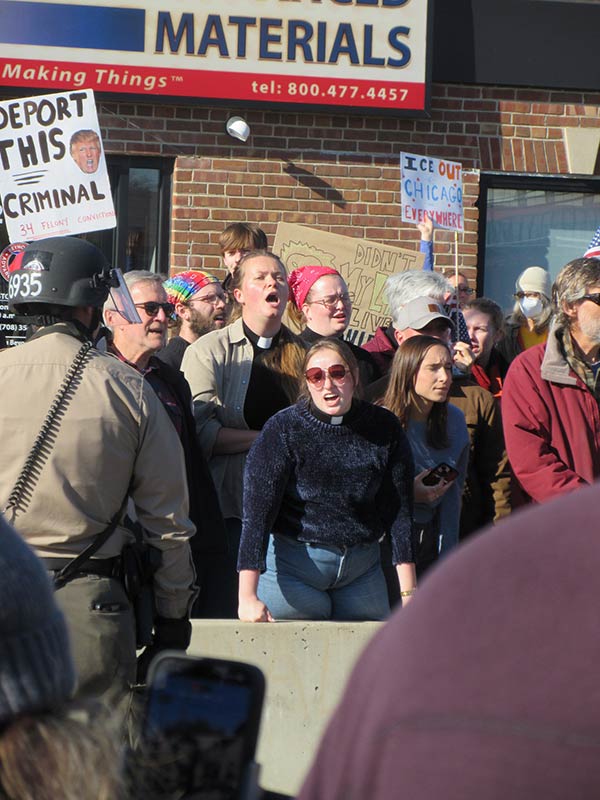

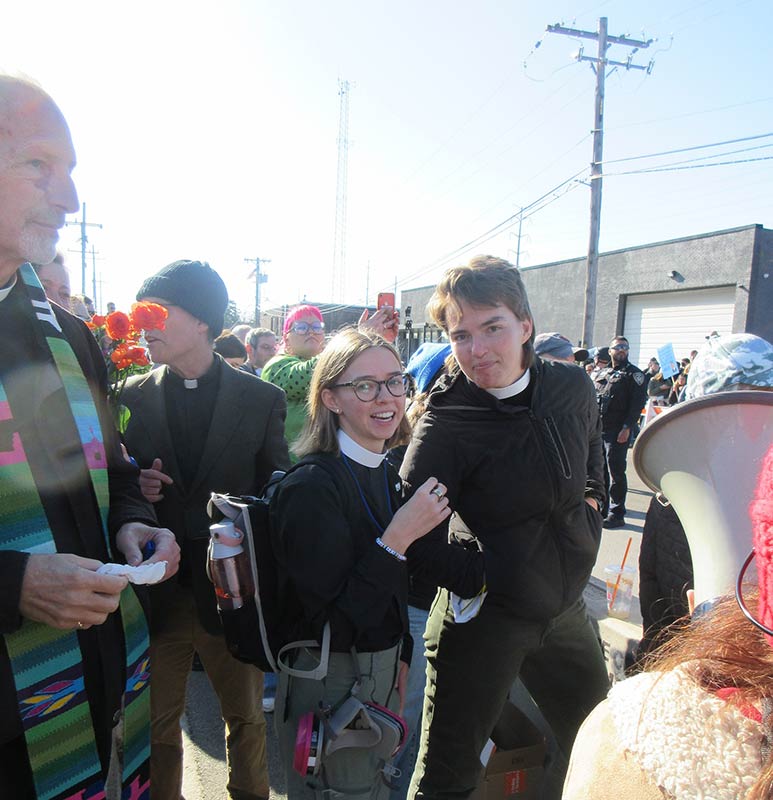

On Friday, November 14, 2025, students from LSTC gathered with hundreds of our ecumenical partners and neighbors at the Broadview Detention Center to pray, to protest, and to stand in solidarity with our detained neighbors. What they witnessed was both the enduring power of multifaith resistance and the stark reality of state-sanctioned violence: clergy linked arm-in-arm met with batons and shields, basic necessities held up in prayer refused at the gate, and songs of liberation answered with force. Yet in the midst of fear and fracture, our students were reminded what generations of faithful advocates at Broadview have long proclaimed: God is present with the oppressed, that human dignity cannot be caged, and that hope endures where people of faith show up, sing loudly, and refuse to turn away. The reflections that follow bear witness to that morning’s heartbreak and its unmistakable call to action. We invite to you to read, reflect, and pray for those affected by the violence of detainment and forced relocation.
Adam Groenke
LSTC Master of Divinity Student
When hundreds of faith leaders from around Chicagoland showed up to Broadview to non-violently protest the state-sponsored kidnapping and torture of hundreds more children of God and members of our communities, we too were met with state-sanctioned violence.
Why is no one allowed in the facility to offer spiritual and pastoral care to those detained?
With no good answer, we sang together “Tear Down the Walls at Broadview”. Leader after leader from so many different faith traditions approached the microphone to insist that our God is a God of liberation, a God who is decidedly on the side of the oppressed, that every human being is made in the Imago Dei.
The list of basic necessities and human rights deprived from abductees filled an entire table, a communal table which we brought to the entrance to embody and accompany our request to be let inside the facility to offer spiritual care, along with these basic necessities. The gifts of the table were rejected, and we were denied entry.
Then, some leaders lined up next to each other in several rows, locked arm in arm, hands clasped tightly together, and exited the “Free Speech Zone”, walking steadily and prayerfully forward. As the rest of us sang together, “We’re gonna keep on moving forward, never turning back”, those on the front lines were immediately met with brute and violent force, shoved, batted, pushed, pulled, and slammed to the ground. Many were arrested and taken away, and those left retreated to the “Free Speech Zone”.
The state’s violence perpetuates and enables more and continued violence. God’s children continue to suffer at the hands of this militarized police force turned upon its own nation, if now less in Chicago, then more in Charlotte or elsewhere. As we left, one organizer told me “back to the drawing board”.
Liza Johnson
University Chicago Divinity School Mdiv Student, LSTC affiliate student
On Friday [November 14. 2025], I gathered for the seventh time with people of faith to pray, hope, and work for the release of our siblings detained at the Broadview. By now many have seen and heard the accounts of those present… of the sudden, unnecessary use of violence against clergy and good people of courage as they linked arms and prayed. I’ve witnessed a lot at Broadview, but this was a show of dehumanizing force that still manages to shock me, days later. We should all ask ourselves: if this is what they do to faith leaders in broad daylight with cameras in view, then what horrific violence have detainees been subjected to behind closed doors?
There are many things you may miss in the reporting of Friday’s events: the meaningful liturgy that began our time, as members of faith groups laid items upon an altar– bread, water, a rosary, a toilet seat– representing basic needs that are denied to detainees. The joyous rebellion of singing that gathered and held us together throughout the morning. Even earlier, the Sisters of Mercy rosary group who stood and prayed as they have been for nearly twenty years. Protest takes many forms; Not all kinds are reported.
Though many detainees have now been removed from Broadview under the judge’s order, we should remain attentive to needs that cannot be filled even by a closure of Broadview entirely: dignity for our siblings in Christ who remain literally caged at the margins of this society, in this country built on the espousal of freedom. We have seen these last few months how our institutions of power resist accountability, preferring to inflict and guard their violence rather than see the Divine in the faces of those they harm. After Friday, I am left wondering: if we truly believe that our calls to ordained ministry are bound up in the work of liberating God’s people, then how will we, as people of faith, leverage our privilege to bend the moral arc towards justice, not only in this city but beyond?
Emily Moentmann
LSTC Master of Divinity ’25, University of Chicago Master of Social Work ‘25
Actions at Broadview by religious leaders have been taking place for many years, since 2007 two Nuns were advocating to go to pray with people in the facility. This last Friday a number of us stepped into that legacy, advocating for the same, to offer spiritual care for the imago dei, praying for the people within the facility. This action was a part of living into our call to be with the oppressed. We know that being denied entry is not just about not allowing prayer, but about hiding the conditions within the facility.
200+ religious leaders in Chicagoland signed a letter asking for religious leaders to be able to offer prayer. After worship, prayer and offering, this letter was presented with faith leaders requesting entry; this entry was denied. So we prayed, we sang, and faith leaders started walking toward the facility to request again for entry. I saw non-violent Faith leaders, praying and walking arm in arm, I also saw police with sticks and tasers, hit, pull, shove, and otherwise use excessive force. I saw Faith leaders respond to this with prayer, song and a continual non-violent presence. I saw police shove Faith leaders to the ground, smashing their face on the pavement, dragging them while they were restrained. I heard Faith leaders say, “you are hurting me” and saw police continue doing what they were doing without regard for the injures they were causing. At no point did I see any police offer injured or escorted by other officers as if they were injured; despite this I did see faith leaders which were detained unable to walk with an even gate.
To make it clear, faith leaders present at the detention center in Broadview Illinois on Friday the 14th 2025, exercised their right to peacefully a non-violently protest, the atrocities happening behind the closed doors of the facility and were met with excessive force by police (state and local) present.
Throughout this encounter, what gave me the most hope was knowing that people inside the detention center could hear that we were there. It matters that they know that we show up. It matters that they know that we still pray for them, and that we know and affirm that God is with them. This is what gives me hope. As time moves onward, I continue to reflect on the legacy of people of faith advocating for those within the Broadview detention center; the legacy that we too in this time have a chance to leave. I continue to reflect on where God is in all of this, that God is truly in the side of the oppressed and with every person within this and many other facilities around the nation. This is where I am drawn to.
Lyndsay Monsen
LSTC Master of Divinity Student

Jesus is Being Detained at Broadview
A reflection on the protest of November 14, 2025
“We’re gonna keep on moving forward, we’re gonna keep on moving forward, we’re gonna keep on moving forward, never turning back, never turning back.” These were the words I sang on Friday, November 14, outside the Broadview ICE facility alongside clergy colleagues of many faiths as we attempted to bring communion to those detained inside the facility. And as the police arrested and dragged many faith leaders away, one by one, our refrains turned to, “we’re gonna keep on singing loudly,” “we’re gonna keep on loving boldly,” and “we’re gonna work for change together.”
It was a morning that I will not soon–if ever–forget. It was a morning that reminded me that God is on the side of the oppressed and that God does not bless cages. It was a morning that laid bare the most sinful parts of our society today, as the state repeatedly chose to meet our messages of peace, hope, and justice with brutal violence.
Prior to the arrests of 21 faithful comrades, the hundreds of us gathered there that morning held a multifaith prayer service. With guitar softly strumming in the background, leaders across various denominations took turns sharing about resources the detainees inside the facility have reportedly gone without access to: clean toilets, safe drinking water, toothpaste. Indeed, the conditions in the building where our neighbors are thrown after being dragged off the streets of Chicago, many are saying, are deplorable. And gathered outside on the sidewalk, just mere yards but somehow worlds away from these neighbors, we responded to each faith leader’s message with refrains of, “God demands freedom!”
One image that continues to haunt me nearly a week later is that of a pastor holding up a loaf of bread, explaining how those held inside have allegedly been going without access to ample food. Maybe it’s because just moments later we were denied the right to bring detainees the bread and the wine, maybe it’s because I had just been at the Metro Chicago Synod’s Rostered Ministers Gathering where I heard Bishop Regina Hassanally of the Southeastern Minnesota Synod give an excellent presentation titled “The Broken Table: brokenness and re-membering at the communion table,” but all I can think about related to this image is how broken the body of Christ is right now, yet how God meets us in that breaking.
That morning on Beach Street I watched the world break wide open.
And maybe, just maybe, the communion table is really just a bunch of brokenness coming together to make something new, and that it is through Jesus we will find the wholeness of peace and justice for which the world longs.
As the morning wore on and new waves of Illinois State Police officers emerged with batons, shields, and even tasers, our singing turned to the words, “Which side are you on? Which side are you on? Which side are you on, my people, which side are you on?” I found myself looking into the eyes of everyone there that morning—including and especially police officers—begging for hearts to be turned to the gospel. Because “which side are you on?” to me does not ask necessarily ask if you are on the partisan left or partisan right, but if you are on the side of justice.
I continue to show up at Broadview because I am gravely concerned about what is happening to my neighbors. I am also concerned about my soul, and what I will tell future generations decades from now when they ask what I did in this moment.
I show up because my faith tells me it is a moral imperative. Jesus says in Matthew 25 that whatever we do to the most marginalized in our society, we do to him. That is why I write that Jesus is being detained at Broadview. Jesus is with every person in Chicago and beyond that has been ripped from their community in recent months.
And Jesus is with us as we call out injustice, as we cry, “shame!”
Jesus is with us as we imagine a better world
Hannah Peterson
LSTC Master of Divinity Student
A Reflection on ICE in Chicago
I am an Army officer and a veteran; I spent eight years studying and practicing (at a huge expense to US taxpayers) the tactics of US warfare, training that goes largely unused because I don’t find myself in military engagements often.
Which is why, when I finally got to Broadview ICE Detention Center on a Friday morning in mid-November, I was sad but not surprised to recognize familiar patterns: the US is waging war on us, here. You’re welcome for my service, let me tell you how I know:
When empty of people, the most unusual aspect of the quiet suburb which made up the Broadview Engagement Area of Operation Midway Blitz that Friday morning were the concrete traffic barriers lining the street to the ICE facility. These barriers created narrow strips of public land between the chain link fences on one side and a retail store on the other; these areas are officially called “Free Speech Zones,” or FSZs, where people are allowed to gather, within certain hours, for protest.
Does it sound odd to you that there are limited areas designated for free speech? Note, especially, if it doesn’t.
On this Friday morning there were about two hundred people gathered in these FSZs for a multi-faith religious service. We were split down the middle by the concrete barriers and lines of armored and armed uniformed people lining the road and obstructing the aisle between us. When faith leaders had previously attempted to conduct religious service for those detained in the buildings, they were denied. And denied again. And denied again. This denial of constitutional rights had gone on for decades before the President of the United States announced the official military operation and occupation called Midway Blitz.
The people inside were stolen from their beloveds. The State confines them in inhumane and sick conditions, such that the State is more afraid of the outrage that would spark if we were allowed to witness it than they are of the outrage sparked by denying the constitutional rights of those inside to religious services.
The religious leaders–some who may be more familiar with these buildings and systems after decades of protest and prayer than you are with your own church–organized a multi-faith service in the Free Speech Zone. During the planned service of the protest, religious leaders spoke one after another. Each would take the microphone, hold up a symbolic basic necessity including a tooth brush, a loaf of bread, a pillow, a towel and soap, a toilet seat, and preach to the two hundred why it was in accordance with their religion that those people restrained inside deserved to have access to these things, as much as any other created in Imago Dei. It was a powerful, simple service, with powerful, simple demands.
Please listen to me:
Have you ever been restrained, unallowed to leave? Have you ever been trapped?
I think you have.
If you have been detained and arrested by the police, you have experienced this. Your restraints were physical as well as legal.
If you have been deployed to the northern border of South Korea for nine months, like me, then you have also been unallowed to leave. Your restraints were also physical, but not like someone who suffers arrest or is held in a prison. Still, your restraints were physical, and legal.
If you stayed in an abusive relationship for fear of starvation or homelessness or shame, you have also been contained. Your restraints were also physical, also legal. You were also not allowed to leave.
If you have been forced to stay in a draining or joyless job or to go to work instead of staying by the bedside of a sick parent or child for fear of losing needed income or health care, you have also been trapped.
If you felt anxiety or pressure to attain certain standards, be perceived to try a certain amount, or show up in a certain way that was not true to you when your body or beloved begged for a break; if you feared judgement or punishment professionally, socially, or politically, then you have also been coerced, forced, and trapped.
I want to ask you: When you were restrained, did you also have that icky, small feeling behind your ribs? Did you also feel your focus narrow? Did you also lose capacity for joy, ease, pleasure? Did your relationships suffer, did you lose sight of tenderness; did you hold tightly to the memory of having a generous heart while your actual heart became cold? Did you, more than you would have liked, turn away from the holy in others, too?
You know from this, or something like it, that being trapped is not what God designed you to be. You were made for freedom; the holy in you longs for freedom.