What a Return on Your Investment Looks Like
The faithful formation of the ELCA’s next presiding bishop
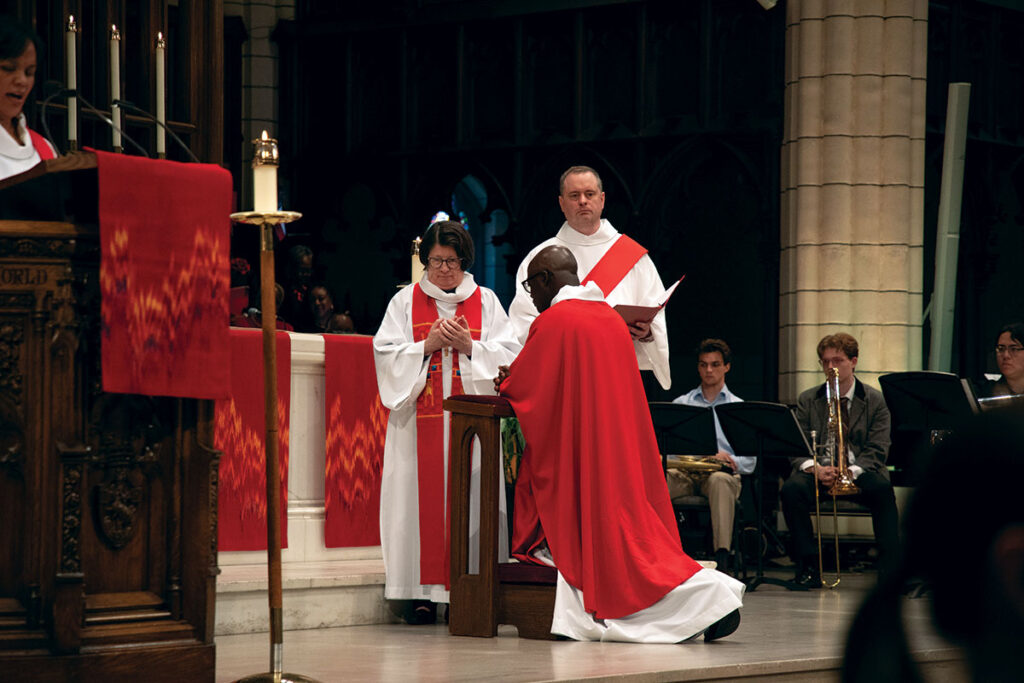
On the night he was elected Presiding Bishop of the Evangelical Lutheran Church in America, Bishop Yehiel Curry, then serving as bishop of the Metropolitan Chicago Synod, limped to the podium (golf mishap, he confessed) and did what he has always done: he started with family, then he turned to formation.
“I’m what a return on your investment looks like,” he told the assembly, his voice equal parts joy and accountability. The line landed because it was true: true of the congregations and communities that raised him; true of the Metropolitan Chicago Synod that recognized and nurtured his gifts; and true of LSTC, the seminary that met him exactly where he stood—and then taught him to lead beyond it.
When the applause fades and the headlines tally their numbers, our story slips past the dais and into the rooms where a vocation was made: Tuesday-night classrooms that spilled into Wednesday pulpits, chapel light that taught another language of prayer, conversations that widened his field of vision.
At LSTC, ministry was rooted in calling and community, in neighbors and relationships. Here, theology learned to walk the city, to notice power and pain, and to imagine a world of possibility and promise. If you want a glimpse of the ELCA’s future, begin where this bishop’s roots ran deep: inside the formation that taught him how to imagine what has never been and to bring others with him on the journey ahead.
A Journey to a Seminary Hiding in Plain Sight
Curry’s LSTC story begins long before he considered course numbers or syllabi on campus. He grew up in Woodlawn, on 61st and Woodlawn, walking past the seminary’s former building at 55th and University without ever quite seeing it.
“I walked past that building throughout childhood and never knew it was there,” he recalls. Weekend treats meant Hyde Park ice cream. Summers meant caddying at Jackson Park Golf Course, saving enough for a plate at Ribs ’n’ Bibs. The neighborhood imprinted him; the seminary, as yet unseen, stood inside that imprint.
When he eventually crossed the threshold as a student, he brought the neighborhood with him, literally. “When I was taking classes, I used to pick up my children from the local grammar school,” he says. “They would sit on The Shelf and do their homework. I’d check in on them dyring breaks.”
It wasn’t just that LSTC welcomed a working father with a full ministry plate; it was that the seminary became the family’s third space: a place where vocation, parenting, neighborhood, and study could comfortably comingle.
Even earlier, Shekinah Chapel, the synod authorized worshiping community that would become the congregation Bishop Curry later pastored, was using LSTC classrooms for Bible study.
“My first time in class, I remember my thought was, I’ve been in this class before,” he says. For Bishop Curry, seminary was déjà vu and ministry was continuity. Indeed, formation was never separate from the neighborhood; it was the neighborhood’s classroom.
The Call That Interrupted a Career and Rewrote a Life
Before seminary, Curry was on a different path: teaching, social work, then sales. In fact, before starting at LSTC, he had taken the entrepreneurial leap to open his own office. The financial services trajectory was both promising and costly. Then Shekinah and synod leaders asked him to consider becoming a lay mission developer. Saying yes, he discovered, wasn’t just about a role. It required formation.
“What drew me to theological education might be seen as a burden,” he explains with candor. “I thought I was just gonna be the next big thing in sales. After about a semester at LSTC, I realized that I couldn’t do both, and I felt more and more drawn to the ministry than I did financial services.”
The practical tensions were real: income, family, responsibility. “My wife had always been the breadwinner,” he says. He worried about repeating a familiar pattern where he would return to school and she would shoulder more of the load. But there was also the urgency of community.
“In order for Shekinah Chapel… to continue on its journey, they needed a person to lead them. And I needed to complete the requirements for the [TEEM] program in order for that progress to continue.” He made a bargain with himself – finish the courses so the church could continue to exist.
In the process, he discovered the shape of his ministry, and LSTC discovered the kind of leader its mission is designed to form: a builder in the world, not just a thinker about the world.
TEEM at LSTC: Learn on Tuesday, Lead on Wednesday
The TEEM program at LSTC was designed so that faith leaders like Bishop Curry could attend to their call while living their lives. It’s an ELCA leadership formation process designed for people serving in emerging ministry sites who have been identified as candidates for further study by their synod bishop. Bishop Curry was one of those individuals. A primary reason Bishop Curry has been such a powerful advocate for the Theological Education for Emerging Ministries (TEEM) pathway is that he was able to use what he learned immediately to advance his call.
“What I appreciated most about the classroom was that I could learn something on a Tuesday and try it out at the church on Wednesday,” he says. “I was hungry for whatever the seminary could give me because it’s almost like I had my own sandbox.”
That sandbox wasn’t just homiletical. It was organizational. TEEM formation pressed him into leadership development. He had to build capacity at Shekinah even as he studied.
The classroom catalyzed ministry structures. Bishop Curry took advantage of everything the program had to offer, notably launching a lay preaching cadre at Shekinah. “One of the leaders… is a guy by the name of Jason Williams who happened to go through the [TEEM] program and is now the pastor of Shekinah Chapel.”
This is the LSTC pattern writ-small and then large: formation that multiplies leaders.
And it wasn’t just one class at TEEM that set the pathway; it was the community of scholars, advocates and faith leaders that provided the opportunity for Bishop Curry to advance his call holistically.
Dr. Linda Thomas’s constructive theology course introduced him to “intersectionality,” a word that “was a mind shift and allowed me to see ministry in a way that I realized I had blinders on.”
Professor David Rhodes (in a Gospel of Mark course) asked students to memorize and deliver Scripture, unlocking Curry’s oratorical gifts. Dr. Katie Billman’s course on death and dying knit classroom to CPE nights on call at the University of Illinois at Chicago Hospital. These aren’t discrete academic moments; they represent the ecology of LSTC, a faculty and curriculum that assumes ministry is public, contextual, and communal.
Indeed, even when the learning was hard, it was formative. Dr. Ralph Klein, Curry remembers, met him in the gap between what he sought (“a Bible college”) and what he had found (“a school of theology”). Klein insisted he go to chapel “because I want you to be bilingual,” Curry paraphrases, able to move between the worship life embodied in LSTC’s chapel and the worship life he knew on the South Side. The point wasn’t conformity; it was fluency. Public church leaders must speak more than one liturgical dialect, and Bishop Curry was going to master multiple.
From Asterisk to Advocate: Returning for the MDiv
Early on, TEEM could, to some, feel like a two-tiered system in the wider church. One member of the committee supporting Bishop Curry’s pathway, the panel that had to sign off on his approval for finishing TEEM, even wrote on an approval document that they hoped he would return to LSTC for an MDiv. The note may have been well-intended, but it was also wounding.
“I didn’t want to be known as the person with the asterisk,” he says. He made himself a promise: if he ever had a role with influence, he would “erase that asterisk.” He would lift up TEEM as a viable, rigorous pathway: not lesser than, just different.
While waiting for ordination in 2009, he began taking the courses he had missed, often at his own expense, two at a time, filling in gaps, connecting dots, and “falling in love with the process.” Shekinah became an organized congregation in 2012; he completed the MDiv in 2013. The timeline matters because it showcases the both/and that LSTC refuses to relinquish: both immediate authorization for urgent ministry and long-arc formation; both contextual leadership and academic depth.
This is also where LSTC’s institutional learning intersects with Curry’s story. The seminary has reimagined its TEEM pathway in recent years: it is now integrated with asynchronous learning through Project Starling, precisely so committed leaders can be formed in place. When Bishop Curry says LSTC “said yes” to revisiting TEEM, he is affirming that the institution listened to the lived reality he embodied and then re-designed for impact.
Builders Build: Mission Developer, Pastor, Bishop
Curry’s leadership biography is the arc of a builder. From 2009-2012 he served as a Mission Developer. From 2012-2019, he served as a Pastor. Then, from 2019-2025, he served as Bishop of the Metropolitan Chicago Synod. Today, he serves as Presiding Bishop of the ELCA. The titles changed; the verbs did not. He organizes, apprentices, develops, and then hands off.
The apprenticeship pattern he learned and refined: “I do; we do; you do; you teach,” is not just staff coaching jargon for him; it’s ecclesiology.
“I’ve always approached this as somebody who’s leaving,” he says. “If you always know you’re leaving, the goal is always to make sure that information is passed on.”
That sensibility is why he could say, even as a sitting bishop accepting the nomination for Presiding Bishop, “I won’t end my career in a Bishop’s office. I’m a builder…and I have to build it again.”
It is also why his synod work focused so intently on creating multiple entry points for leaders, especially leaders with deep community roots and vocational commitments that do not fit a residential, full-time model. In Chicago, that included a bivocational approach and a six-year covenant for TEEM candidates serving congregations, made up of three years of supported study and service, followed by three years of committed leadership. It also included creative use of Synod Authorized Ministry (SAM) to sustain sacramental life as candidates progressed.
The results? “I could think of four to five congregations that didn’t have [any] leadership but now have had consistent leadership and they’re doing really well,” he says.
That is not a small thing in a church wrestling with pastoral shortages, changing demographics, and institutional fatigue. It is, in fact, what investment looks like.
A Seminary That Learns Alongside Its Leaders
One thread runs through Curry’s story is that he never learned alone. LSTC’s faculty challenged, encouraged, and stretched him; classmates became colleagues; his congregation learned alongside him. That last piece is crucial.
“I always wondered during that time, can the congregation learn what I’m learning right now?” he says. It was a question that leaders at LSTC considered with great hope and even greater clarity of purpose. Today, with Project Starling’s asynchronous pathways and the seminary’s renewed attention to lay formation, the answer is increasingly yes.
When he served on LSTC’s Board of Directors, Curry pressed this vision. “There’s a hunger here for some education,” he told colleagues. “And I think the seminary is the best place for us to receive it.”
He dreamed out loud about a teaching congregation where LSTC’s preaching labs and curricular experiments could bless a neighborhood in real time. Imagine students preaching in a real sanctuary to a real community, where the feedback loop includes not only a rubric but the responses of people who will live with the sermon all week. Imagine Sunday school curriculum piloted by families who will tell you the truth. Imagine stewardship campaigns designed with the community, not simply for it.
That is public church in action: not a slogan, but a commitment to showing up, learning with, and building capacity in communities rather than extracting from them.
Curry’s leadership is deeply pastoral and unmistakably public. In January 2021, after the insurrection at the U.S. Capitol, he wrote with stark clarity about the racial double standards on display: “If it was us, we would’ve been shot.”
It was not performative outrage; it was pastoral truth-telling grounded in lived experience and theological conviction. That voice was honed in classrooms where intersectionality reframed what counted as “theological,” in chapels where multiple worship idioms taught bilingual fluency, in neighborhoods where the church’s public witness is measured by the lives it accompanies.
This is a hallmark of LSTC’s formation: we prepare leaders who can love their people and lead them into the world with eyes open. It is why Bishop Curry’s preaching, board service, and synod leadership have continued to name white supremacy as sin while calling communities toward hope, relationship, and action. The pairing—truth and hope—echoes LSTC’s values: justice rooted in Scripture, hospitality that crosses difference, and leadership formed for the sake of the world God loves.
Why LSTC? Because Public Problems Require Public-Church Leaders
In this moment of historic celebration in which we honor not only a remarkable LSTC graduate who cemented traditions with the courage that would make historian Eric Hobsbawm blush but also the election of the first African-American Presiding Bishop of the ELCA—a denomination that was found to be 93% white in a study done by the ELCA in 2024—it is fair to ask: what about LSTC made this story not only possible but, in a sense, inevitable? A few distinctives rise to the surface of Bishop Curry’s journey.
This is a hallmark of LSTC’s formation: we prepare leaders who can love their people and lead them into the world with eyes open. It is why Bishop Curry’s preaching, board service, and synod leadership have continued to name white supremacy as sin while calling communities toward hope, relationship, and action.
First, LSTC was and remains committed to doubling down on contextual, flexible pathways: from a revitalized, credit-bearing TEEM to asynchronous and hybrid learning through Project Starling to opportunities for remote students to engage with residential students in traditional degree pathways, the institution understands that serious leaders live complicated lives. Curry’s children did homework in LSTC’s hallway while their dad did Greek paradigms; he left preaching lab and built a lay preaching lab at Shekinah. That bi-directional flow—classroom to congregation, congregation to classroom—is the seminary’s design principle, not a workaround.
Also, LSTC celebrated intersectionality in a way that was lived authentically by the wider community. “Intersectionality” wasn’t just vocabulary for Curry; it was conversion. LSTC’s faculty teach theology with a public lens: race, gender, economics, health, migration, because the gospel is already out there in the world’s fractures. Leaders formed this way can say, with credibility and courage, “If it was us, we would’ve been shot,” and then convene communities for healing and action.
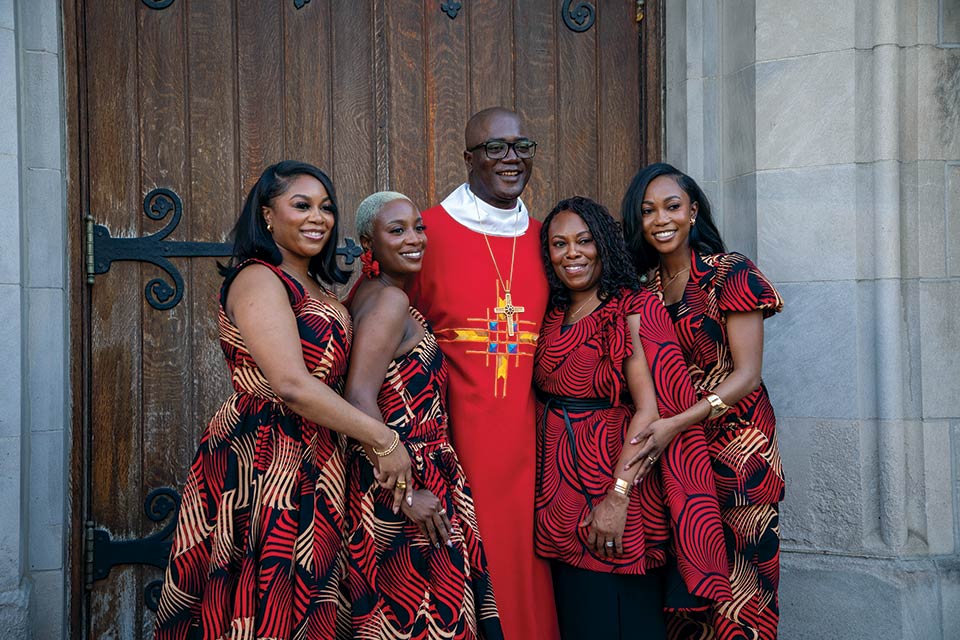
As Bishop Curry indicated in his acceptance speech, LSTC understood then and understands now that the key is in multiplying leaders, not just credentialing them. From preaching labs that beget lay preaching cadres to board-level advocacy for lay education, LSTC’s question is never simply, “How do we train you?” It is also, “How does your formation multiply formation in your context?”That’s how a TEEM mission developer becomes a pastor who becomes a bishop who becomes a presiding bishop—and no one walks that path alone.
Finally, Curry’s vision of a teaching congregation is LSTC’s dream, too: seminary and church as co-laborers. The same posture animates the seminary’s developing work with SAM preparation and multiple pathways for authorization, in collaboration with synods who know their contexts best.
When Bishop Curry says, “People will support what they help to create,” LSTC hears an affirmation of our commitment to reimagining a just and bold future. As Bishop Curry’s journey shows, leadership is out there in unexpected places. LSTC has long understood that it is more than worth the effort to meet people where they’re at in order to realize the formation that lives in their spirit.
Ask Curry about his most vivid LSTC memories and you’ll hear the geography again: Woodlawn and Hyde Park; St. Thomas across from the old seminary building; kids doing their homework on campus; nights on call at UIC Hospital; Bible studies that migrated from Shekinah to LSTC classrooms and back. The pattern was never cloistered study then supervised ministry. It was study as ministry, ministry as study.
That is why his leadership voice rings with both reverence and realism. He honors the chapel and the community. He loves the liturgy he learned to speak fluently and the worship life that first gave him a voice. He can preach to a Churchwide Assembly and end with a plea to bring others along in the learning, because that is how he was formed.
It is tempting to treat an election as the exclamation point at the end of a sentence. In Curry’s case, the punctuation is different: more like a semi-colon. What follows are the apprentices who will lead, the congregations that will stabilize and flourish, the lay learners who will finally get the theological education they have been asking for, the multiple pathways that will hold people who have three jobs and a call to preach in holy sanctity.
Curry’s apprenticeship model, which he mentioned at Churchwide in 2025, “I do; we do; you do; you teach,” is also a curriculum. It is what LSTC’s cohorts do every day. We learn together in the hope that our learning widens the circle of leadership. It is how TEEM candidates become pastors who become mentors. It is how a preaching lab becomes a cadre. It is how a seminary becomes a public good, and how we meet the public church in times such as these.
And it is, finally, how a boy who once walked past a building he did not recognize could later stand in that same neighborhood: older, wiser, limping a little, grateful a lot, and tell a whole church what a return on their investment looks like.